Culture Will Eat Your Policy for Lunch

In preparation for our Academic Distinctions episode on Bloom’s Taxonomy, Stephanie and I read the work by Bloom et al. that started it all. One of my favorite quotes attributed to Bloom is that the taxonomy is “one of the most cited works in education which no one has ever read.”

So, it made sense we would get to work reading it. If you’re curious about the history of the taxonomy and how it went from trying to come up with a common way of naming the kinds to things educators were asking students to do on exams to the seed of objectives on the board and “higher-order thinking,” check out the episode.

What you won’t hear in there (and what has been hangng in my head since reading the book) is what I’d consider a key piece of how Bloom and colleagues envisioned the content of the book being used.

The philosophy of education of the school serves as one guide, since the objectives to be finally include should be related to the school’s view of the “good life for the individual in the good society.” What are the important values? What is the proper relation between man and society? What are the proper relations between man and man?

Finally, educational objectives must be related to a psychology of learning. The faculty must distinguish goals that are feasible from goals that are unlikely to be attained in the time available, under the conditions which are possible, and with the group of students to be involved. The use of a psychology of learning enables the faculty to. determine the appropriate placement of objectives in the learning sequence, helps them discover the learning conditions under which it is possible to attain an objective, and provides a way of determining the appropriate interre lationships among the objectives.

Can modern schools do this? Do modern schools have a shared philosophy of education? Do they ensure all educators on their faculties have our best understandings of the science of learning – what Bloom & Co. called psychology of education?

No, right? And, when we came back from emergency remote learning where every teacher had been operating on their own philosophy of education, we jumped back in head first and with both feet (I don’t know how that works) pretending normal hadn’t shifted.

If I may paraphrase Peter Drucker, culture eats objectives for breakfast.

Way back in 2009, Simon Sinek’s “Start with Why” TEDx Talk started making the rounds in faculty and leadership team meetings around the world. Everyone and their intern was asked to talk about their “why.”

Sinek was re-imaging the work organizations had been doing for decades in drafting vision and mission statements.

Why are we doing what we’re doing?

The interesting thing in Bloom is the assumption schools and other organizations dedicated to learning were coming to learning objectives with shared philosophies of eduction and understandings of the science of learning.

Despite our compulsory viewing/reading of Sinek, we don’t have those.

We got close at the height of the charter school movement. I’d argue some of the draw of no-excuses schools was that we could look at them and know what they were about. They were/are built on a shared philosophy of education (so very distant from the science of learning).

It’s what Chris and I write about in Chapter 6 of the book, “Vision must live in practice. It’s also why it’s so early in the book. If we don’t start there, we will end so many unintended places.

Responding to a professor today in an online forum about AI in education, I realized we’re at another moment that is calling us to build practice on a shared sense of what we believe and know about learning. If we can’t name these things within our schools with a common voice, well, AI will be a mess.

Some states and districts have issued briefs and policies on the use of AI in schools. Utilizing the moment to say, “This is what we believe about the thing and we will all believe this about that thing.”

Great.

And what do we all believe about how people learn best and how schools can support that learning? Without shared understanding of those elements, well, culture’s happy to move on to policy after it’s finished with objectives.

Culture is insatiable.

20 Jan 21 – One Good Question

For those keeping track, I went on another lunch run today. That’s three in the last four work days. Running has always been where I get my thinking done. I ruminate.

Today, I was thinking about classrooms – physical, digital, and those who have yet to make up their minds – and how I know they must be struggling to create the communities that must be established as foundations of learning.

I started thinking about what I would do. I came up with questioning. This is not surprising for a guy who really hangs his hat on inquiry. For this, though, I was trying to think of something a teacher could implement with absolutely no prep and yet reap a deep benefit in shoring up community.

The idea is to challenge students to come up with one good question they would be interested in hearing their peers answer and would be okay with answering themselves. Then, they pair or group up and share their questions and answers.

Sure, sure, there can be reporting out, sharing, and asking who had similar questions or answers. But, there doesn’t need to be. All that’s necessary for community to begin to form is for people to try to find out about one another and to share a piece of themselves.

Not having a classroom of my own, I used our dinnertime conversation as a testing ground this evening. “Think of one good question you want all of us to answer, and we’ll take turns answering.”

They wanted a model, so I went first. “What’s one thing that can almost always make you smile when you are sad?” Tickling was a popular response.

My daughter was next, “What do you like about doing our gratefuls?” Our “gratefuls” are our nightly ritual of putting a coin in a mason jar and sharing at least one thing we are grateful for that day. Hearing what both kids thought about the process was wonderful.

The boy went last, “Are you afraid of heights?”

I had to think about my answer. I wasn’t sure. Turns out, yup, sometimes.

So, with one text audience of kids who will definitely let me know if one of my ideas is bad or stupid, I had a 100% success rate. You will too.

Try it tomorrow. Even if those you’re learning with are adults. All it takes is One Good Question to bring us closer.

How Do We Begin to Create a Culture of Reading and Writing?

Boy reading book on the floor of a book store.“Do me a favor,” I say, “and close your eyes. I’m going to ask you to visualize something. If I told you you’re visiting a school with a healthy culture of reading and writing, I want to you visit it in your imagination. Start with the lobby or entryway. Notice everything you see and hear as you walk through.”

The exercise goes on for about thirty seconds. I ask the assembled room of teachers to walk the halls, look in on classrooms, listen in on the conversations in common spaces and between the folks they pass in hallways.

I ask them to pay attention to the adults and to the students equally. “Everyone is responsible for creating and sustaining culture, so make sure to observe and listen in on everyone.”

When each teacher has finished their tour, it’s tie to write. “Take five minutes and put it all out in writing. Capture as much of the detail as possible. If you draw a blank, keep writing, ‘and, and, and, and,’ until your brain fills in the holes. Trust that it will.” And, the room takes five minutes to write.

Next, I ask them to share with someone else in the room, not reading the writing verbatim, but distilling to key ideas. I limit the time to talk because conversations at this point are fully-fed and reproducing like tribbles.

The final step, jumping into a shared and open google doc where they answer one question as many times as they can, “What would it take to create the kind of culture you envisioned in your school?”

Again, the activity is timed. Most of the time, I’m having this conversation as a drop-in to a larger meeting. There are other atomized conversations about literacy on the agenda.

I’ve run this conversation several times in the last few months. As the language arts coordinator, it’s one of my favorites. The creativity and joy it elicits each time can be unfamiliar for your average professional meeting.

All of that said, we need to be having this conversation or some variant thereof as much as possible in schools of every level. From pK to 12, we need a picture of the kind of culture of reading and writing we’re hoping to inspire and establish if we want the people in our care to see themselves as readers and writers who aspire to ask and answer better questions.

Here are a few things I’ve noticed in each iteration of this conversation:

  • No one – no matter their subject area – has ever said, “I don’t know” at any point of the process.
  • No one has argued with the assumption what they’re being asked to envision is not important, worth their time, helpful to students, or a better version of what learning and teaching can be.
  • Once they get started with the writing and the talking and the coming up with ideas of how to make it work, the conversations are difficult to curtail or contain.
  • Almost every single idea these teachers generate for how to shift the culture of their schools is free to implement. When it’s not free, it’s low-cost or an idea any PTO would be thrilled to help realize these ideas.

So, let’s do it. Let us build a context around the atomized skills we’re all-too-clear our students need help building and then make it the norm that every person in our care instinctually knows our schools are places where our implied shared identity is one of curious readers and writers.

Check out this hella wicked awesome jawn, y’all

Language

In first grade, my mom and I moved to Kentucky. While only for a year, my grandparents’ worst fear was realized. I came back with a tiny drawl, an ability to pronounce Louisville like a local, and a proclivity for “y’all”. In adulthood, I’ve lived in some linguistically diverse places. As a result, I’m somewhere between a colloquial mutt and a carpetbagger of words.

From my northern California connection, you’re likely to hear “hella“. It only took a year in Boston for me to see the beautiful malleability of “wicked” (see also “wicked awesome”). Four years in Florida brought “y’all” back into my life. Nowhere and no word has proven so utilitarian as Philadelphia’s “jawn” (see also “jawnski”).

These words act as aural tattoos of where I’ve been and are constant reminders of what it meant to be in and of a place. This is to speak nothing of the international words I’ve collected. “Jambo,” “ubuntu,” and “inshallah” from Kenya, South Africa, and Pakistan respectively are only a few of the terms I encountered amongst other people and recognized the value of beyond what America could provide.

More than usefulness, these words are also markers of how I define citizenship in ways that are perhaps different than my parents who have not traveled out of the country or my grandparents who have lived in relatively similar locations throughout their lives. If language is culture, my travels have made me a part of a culture different and connected to the one from which I come.

This is where tools like urbandictionary and Language Log are the most helpful. All that’s necessary is an Internet connection and we can sort through the cultures and micro-cultures of those whom we may never meet. Even if we are not participating, we can have a window into how words and their meanings shape the actions and beliefs of others. These tools represent a museum of the now, sharing the nouns, verbs, and clauses that separate and connect us.


This post is part of a daily conversation between Ben Wilkoff and me. Each day Ben and I post a question to each other and then respond to one another. You can follow the questions and respond via Twitter at #LifeWideLearning16.

Are we talking our problems into existence?

As part of Connected Educator Month, Chris and I are having a great time hosting a book study of Building School 2.0. The questions for Week 2 went up last night, but this post isn’t to get you to join the conversation (though you totally should).

This is because a comment from last week from Nancy Ironside has kept me thinking about changing culture and perceived barriers. In the book, Chris and I call out the ineffectiveness of admiring the problem, and I think there’s some element of that in my reply to Nancy. More, though, she’s got me thinking about narrative creating reality. Below is my reply.

I hear what you’re saying about lip service being paid to innovation and a counter narrative being played out in policy and practice.

One of the things I’ve noted in schools everywhere is not innovation dying in policy or practice (to be sure, these can be killers), but it dying in the commonly-held narrative within a school or district. People start sharing the story that they’d like to do new things. They’d like to try this new approach or practice. But, they cite policy and administrative practices as hindering them. They cite them in that way – unspecific, as though these prohibitive policies and practices were floating in the ether.

When cultures start to change, it’s because people within those cultures do what you mention. They envision what they want the culture of their learning space to be and then they start acting and talking as though that new culture has become the truth.

I had a book when I was young called Donkeys Can’t Sleep in Bathtubs. It was a collection of ridiculous, arcane, and outdated laws that were still on the books in various states. The thing I realize now is that no one was trying to make a donkey sleep in a bathtub, and anyone who happened to try it nowadays would likely avoid jail time. This is the truth about those who decide to change the narrative about what’s possible within our schools simply by acting according to the narrative they’d like to work into existence.

Thoughts?

On Whose Shoulders: Lisa Delpit’s _Other People’s Children_

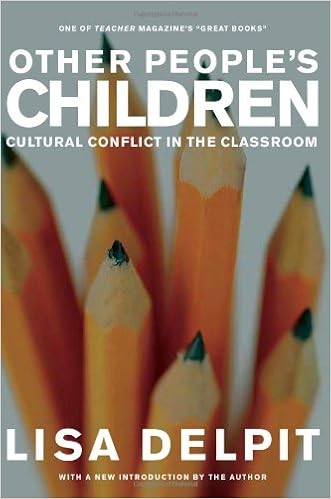
cover of Other People's Children

A quick keyword search for Lisa Delpit on the blog will show I’ve thought and written about her work pretty deeply over the years as I’ve thought about what it means to be the other in my classroom (both as a teacher relating to my students, and for my students relating to me).

As I continue this series of posts about those thinkers, practitioners, and researchers who directly influenced what you’ll find in Building School 2.0 in the run-up to its Sept. 8 release, I cannot say enough about Delpit’s work and this title in particular.

In Other People’s Childrenc, Delpit is challenging, fair, thoughtful, and caring in laying out – over the course of several essays – some key considerations and understandings teachers (particularly teachers who are white) need to take up so that they might be better versions of themselves when working with students who come lived experiences wholly different from their own.

More than anything, I hope you pick up Other People’s Children, select a chapter, and start a lunch-time reading group with faculty friends. The conversations won’t be comfortable or easy, and they shouldn’t be. Most important conversations, most acts of changing your mind, are difficult. That’s good.

I hope, in some small way, Chris and I honor Delpit’s ideas and weave them with those of others.

What are you teaching the next Darren Wilson?

It was on the third page of the front section of the Sunday paper today. If Michael Brown’s parents hadn’t been in D.C. over the weekend, I wonder how much deeper an update on the events in Ferguson would have sunk into the news cycle.

This aligns with my concerns about what I imagine to be happening in classrooms around the country. In the first weeks of school, teacher friends around the country shifted their lessons to include some investigation and conversation around the shooting of unarmed African American teenager Michael Brown by white police officer Darren Wilson in Ferguson, MO.

I can’t blame the newspapers for their reduced coverage. Until something happens worthy of an update, there is no new news.

In our classrooms, though, yesterday’s story must inform today’s lesson plans so that we can help to prevent tomorrow’s Michael Brown and Darren Wilson.

When tragedy strikes, we seek counselors, we make safe spaces for conversation, we hold vigils, we let out a collective, “This happened again” and utter the statement as either a shocked question or a saddened, unsurprised declaration.

Saturday will mark 8 weeks since Michael Brown was shot. Whatever units or lesson plans teachers developed so that they were “doing something” in response to the death of yet another child of color have likely run their course.

They were not enough.

Saturday will mark 8 weeks since Michael Brown was shot. Whatever units or lesson plans teachers developed so that they were “doing something” in response to the death of yet another child of color have likely run their course.

They were not enough.

However meaningful the classroom conversations, however poignant the reflective essays, however moving the student-produced PSAs and podcasts – they were not enough.

Because there will be another Michael Brown, another Eric Garner, another Kimani Gray, and another, and another, and another.

In the small town high school I attended, any conversation about race had to do with the Civil War, the Emancipation Proclamation, and possibly the March on Washington.

I should say any formal academic conversation about race included those topics. The informal conversations were fraught with the ugly contents of unexamined privilege, the exocticizing of the other, and the cultural appropriation of music relatable on an emotional level yet far removed where content was concerned.

My guess would be that Darren Wilson grew up in a similar system.

Cultural sensitivity trainings and body cams will make the difference they can make for the police officers attending them and wearing them, but that difference is nothing compared to the potential power of on-going mindfulness and conversations about race, class and privilege in our schools, classrooms, and hallways.

As much as we should worry about the next Michael Brown sitting in our algebra classes, we must worry about the next Darren Wilson being there as well.

We should feel guilt and shame that we were too weighed down by our own insecurities around these topics, that we dismissed them as too difficult or thorny to broach with students.

Perhaps we let ourselves off the hook by arguing students are discussing these topics at home with their families. That is laughable, dangerous, and irresponsible. And, were it even true, it would be no excuse to avoid adding a layer of complexity to helping our students inquire into the role they want to play in this country’s on-going identity crisis around race.

A lesson or a unit will not change the conversation. Hoping your colleagues in history and English classes are reading books with people of color as main characters will not change the conversation. Engaging in the conversation, again and again, will help to change the conversation.

The next Michael Brown and Darren Wilson are already sitting in our classrooms. What are we doing to make sure their story ends differently?


The following are a sampling of resources for teaching about the events in Ferguson and race in your classrooms. If you have other helpful materials, please add them to the comments:

#wellrED Week 2

José, Larissa, Scott, and I got together Thursday night in an on-air google hangout to discuss Lisa Delpit’s Other People’s Children for the second week running. While the schedule said we’d be talking about “Part 1” of the book, our conversation focused only on “The Silenced Dialogue.”

It was a thought-provoking hour of conversation that I’m still mulling over, and likely will be until next week’s conversation. You can read about the catalyst for the reading group here, and join the group here.

As for my part, I’m enjoying having a space to look forward to each week where race, ethnicity, culture, privilege, equity, power, and other critical issues that are easily overlooked in education is the set focus.

Last week, I switched from the print to Kindle version of the book. You can track highlights and comments here.

More importantly, consider joining in the reading. The book is a collection of essays, so you can easily jump in mid-book. Next week, we’ll be talking about pgs. 48-69. Join the hangout or the twitter chat. Maybe just post to the discussion board. Either way, let’s elevate the conversation and critical thinking around these important issues of practice.

It’s about time to show we’re #wellrED

#wellrED logoEarly February, I announced that Jose Vilson and I were starting a book group through GoodReads for folks whose lives are entangled with education. We saw a general lack of conversation around the tough issues we face in districts, schools, and classrooms, and thought maybe there was something we could do about that.

A little over a month later, and we’ve got about 50 members of the #wellrED group, and are about to start our conversations around Lisa Delpit’s Other People’s Children. Just looking at the group members, I know this is going to include some great dialogue. Folks from all over the US have signed on to think deeply and listen to understand other people’s thoughts around the book.

You should too.

Pick up a copy of Children today. You’ve got plenty of time to read the introduction and forward by the time we post this week’s questions Wednesday. Then, join us Thursday from 7:30-8:30 EST for an on-air Google hangout discussion of what we’ve read and/or join us for a twitter chat at the same time with the hashtag #wellrED.

Being connected gives us a chance to create the type of professional learning we’ve been looking for. Hopefully, this discussion is something you’ve been hoping for.

If you have any questions about any of the above information, leave a comment below, and I’ll be happy to help you get connected.

152/365 Striking a balance between the public and private of schools


From Jane Jacobs’ The Death and Life of Great American Cities:

The more common choice in cities, where people are faced with the choice of sharing much or nothing, is nothing. In city areas that lack a natural and casual public life, it is common for residents to isolate themselves from each other to a fantastic degree. If mere contact with your neighbors threatens to entangle you in their private lives, or entangle them in yours, and if you cannot be so careful who your neighbors are as self-selected upper-middle-class people can be, the logical solution is absolutely to avoid friendliness or casual offers of help. Better to stay thoroughly distant. As a practical result, the ordinary public jobs – like keeping children in hand – for which people must take a little personal initiative, or those for which they must band together in limited common purpose, go undone. The abysses this opens up can be almost unbelievable.

As is, I’m sure, not surprising, I’ve been reading Jacobs through the lens of education and schooling. This lens lends itself nicely to seeing the city as a metaphor for the life of thoroughfares of schools – hallways, restrooms, cafeterias, common areas.

To engender the cultures and climates of healthy, sustainable, supportive schools, we must strike the right balance of public and private. Students should know they are seen, but not feel they are watched or expected to share all the details of what they are doing outside of the day-to-day of schools.

It reminds me of growing up in a small town. My friends and I knew that our teachers knew and saw our parents. We also knew that there was a margin of freedom we were afforded for experimentation into who we were becoming.

The schools we need, like the cities we want, find that balance of private and public and let members of their communities play in all the spaces.

What does this look like? How do we get started?