If You’re Going to Do Test Prep, Don’t Be Horrible (20/365)

Photo by ShareGrid on Unsplash

We will, at a later date, examine me railing against test preparation. For today, though, let’s take a look at the problem below.

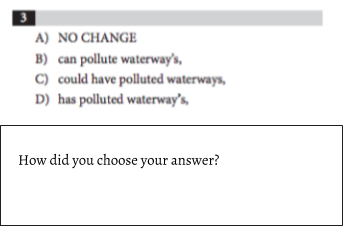
It is not unlike a problem a well-meaning teacher might put in front of their students. Because exposure/preparation/familiarity. Our well-meaning teacher would take this or something like it from a released bank of items on Standardized Exam Ultra and give it to their students to complete. Why not? The items are aligned to standards, the students will see things like this when they take the real Standardized Exam Ultra, so let’s get them started.

Pedagogy aside (and it’s quite difficult not to go off that way), a completed and scored set of these practice items would give the teacher little to no useful information by which he could shift his practice.

Let’s say 90 percent of the class misses question three. What would scoring this question tell our teacher? Well, it would tell him, in a class of 30 students, 27 got the question wrong. What he’d be likely to claim is this shows his students don’t understand verb tenses, commas, and apostrophes. That’s quite a bit to fit into a single question. In reality, there are at least 27 different paths each of these incorrect students could have taken to reaching the wrong answer. Getting this question wrong only informs instruction insofar as our teacher was wondering whether students got it wrong or right.

If our teacher insists on using this form of assessment, I’d point to a few easy tweaks that would provide greater clarity while increasing the cognitive load on students. I’d even go so far as to claim these tweaks would increase the likelihood of the students arriving at the correct answer.

My first alteration is to include a space under each question asking students how they reached the answer they chose. This reveals the paths students took not only to incorrect answers, but correct answers as well. Suddenly, our teacher is able to better understand process. It also moves student reflection into the assessment itself. Rather than asking students why they missed a problem post hoc, we are building a mechanism for students to consider the why of their choices in the moment. Here is the first place I’d argue our group of 27 is more likely to shrink as students pause to think about what they’re doing in ways exercises like these don’t naturally demand. We even put value on answers of “I don’t know.”
What if the shift above isn’t the only move we make? What if we add another space for feedback. This time, though, our students have passed their papers to another classmate and our teacher has asked each classmate to look at the answer and justification of her peer and then reply with her thoughts on the justification? At this point, we’ve begun a conversation, if small, where our students are no longer looking at the answers, but looking at the reasoning and asking if they arrived anywhere worth going.
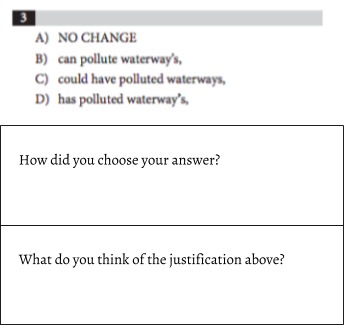
Think, then, of the information our teacher is working with when he collects these papers. Rather than simply knowing if a given student got a question correct or incorrect, he now also knows how they got there and has given all the class an opportunity to chime in on that thinking at the same time.

The next day, he might pull together students who took similar approaches to reaching the incorrect answer and offer some targeted instruction in correcting their missteps. He might not point out the errors, but put our three correct students in a group with 9 other peers and have them work in small groups to consider how they answered and why they made the choices they did.

It is conceivable our class might grow frustrated with our teacher’s lack of simply telling the correct answer. This is good. I’m assuming these students have computers disguised as phones in their pockets and bookbags. When the discussion reaches its highest frustration, our teacher might say, “Okay, see if you can find help online.”

Here, we’ve taken something boring and inauthentic and built a community around it. We’ve manufactured value to something that originally would have told us if students picked the correct letter or the incorrect letter. While this is not preferable to some authentic, contextualized tasks that would also lead students to practice these skills, it is certainly better than we found it.


My Best Moment of the Week: Getting Students’ Feedback (19/365)

students raising their hands in a full lecture hall
Photo by Edwin Andrade on Unsplash

Visiting one of our elementary schools last week to drop something off, I used the chance to visit a couple of classrooms. While I was standing in the doorway of one fourth-grade room, the teacher crossed to me.

“They’re just wrapping up their reading groups,” she said and explained this was the second week of the students working through a menu. Each week groups had a selection of Must Do and May Do activities to work through. It was an added element of student choice and a move on the teacher’s part to better recognize students’ agency.

The teacher told me she’d been impressed with what she’d seen in the first couple weeks and she was working to help the students get used to their new control over the learning.

“And what about the kids,” I asked, “Do you have some sort of feedback mechanism built in to get a sense on how they’re thinking about the changes?”

“That’s a really good question,” she said without missing a beat, “Let’s do that now.”

She called the groups back to their spots and asked them to discuss two questions with one another: What was going well with the new structures, and what could they do to improve the class moving forward?

That would have been enough to make my week. Not only were this teacher and her team trying something new based on a drive to get out of students’ way and better honor their agency, she saw value in hearing students’ feedback to such a degree that she was willing to adjust her plans on the fly to give students an opportunity to report out on what they thought of her new ideas. That, alone, would be enough.

But, that wasn’t the best part.

I perched myself amidst a group of four young women and listened as they talked with one another in response to their teacher’s questions. It was an exchange the civility and earnestness of which I’ve rarely seen in a faculty meeting. Their teacher had given them yet another chance to help chart the course of their learning and they were equal to the task.

As their conversation wrapped up, I asked if I could get their feedback on one more query. “Sure,” they told me.

“Well, your teacher is responsible for making sure you’re learning, right? So, how, with this new way of doing things, might she be able to keep better track of what everyone’s doing and what they’re learning from it?”

A pause as four faces with pursed lips considered my question.

Then, they were at it again. A lot of decisive, Wells as they started tossing ideas around, building on and pushing the thinking of those who’d spoken before them.

My favorite idea came from the student sitting to my left. She suggested students could write a couple of sentences as they finished an activity, relaying what they’d done in their groups and what they’d learned from it. Then, she said, they could take pictures of their writing and share it on Seesaw so both their families and their teacher could see their thinking.

I’ve been in 3-hour meetings with teachers where only at the end did we get to an idea as clear and salient as hers.

To anyone who’s been following these ideas for a while, it should be clear why these moves of practice and these ideas brought me so much joy.

What might not be as clear is the joy I took in the ease with which these students had their conversations and shared their ideas. You might not see my joy at how quickly their teacher considered a new idea, modified her plan for the day, and sought her students’ feedback. The ease and comfort of all of this bring me joy because they signal this is the normal for this classroom. Conversations, democracy, feedback, honoring students’ thinking – they were all taken in stride. That is evidence they don’t just happen when visitors are in the room. That brings me joy.

Stop. Drop. Listen. (18/365)

one person taking notes while another speaks
Photo by Nik MacMillan on Unsplash

I started a meeting with silence last week. We’re not talking the usual, mildly uncomfortable moment of silence that comes up every once in a while. Instead, I started this meeting with seven minutes of silence.

I’d drafted an idea for a team of teachers at one of our schools and decided to present it for their consideration in a way requiring no presentation.

“Okay, instead of talking this through, without talking, I’d like you to review the document and put all of your questions and comments in the margins as they come up.” A couple of the teachers looked at me to discern if I was on the up and up. I assured them I was. About 30 seconds in, one teacher said, “Well, here’s the thing…”

“Just put it in the margin,” I said, impressed at myself for not taking the bait of conversation.

They typed, I watched.

They typed some more, I watched some more.

I read as they as they added every question and comment that entered their heads.

Maybe two minutes into the process, I noted one of the teachers was inserting comments I’d classify as having a critical tone. From her first comment to her position midway down the first page, each time she hit option+command+m, the result was a reason why what I was proposing would not work. It continued this way for the remainder of the seven minutes. Though I’d told myself I was presenting a draft document and had said aloud to the room that I wanted to show them something we could make representative of the team, I was getting defensive.

As I scrolled through the comment, the voice in my head responded with Yeah, buts and Here’s what you don’t understands. She was missing the point of what I’d created.

By the time we hit the 7-minute mark, it was all I could do to stick with my plan and say, “Okay, now how would you like to proceed?” Others in the room started the conversation and kept driving. While I engaged and listened to their thinking, I was always half-listening for my critic to chime in. It took a while until she added her voice.

When she did, it wasn’t to voice one of the criticisms or reasons why one of the ideas would not work. It was to ask a question and then another to get clarity of the way everything might proceed. In fact, not once in the entirety of the conversation did she give direct voice to the ideas she’d written in the comments. Instead, I noticed she was making each comment into a question, searching for clarity and help thinking through how what I’d proposed might be made to work with their students.

The more I listened to what she was adding to the conversation, the more I realized she wasn’t the foe I’d assumed she’d be as I was reading her comments. She was an ally. She was an ally who’d done exactly what I’d asked and thrown her initial thinking into the document, shared what her gut told her would be hurdles to overcome in shifting the way the team had been doing things.

What I’d read as pessimism and inertia was this teacher trusting me and trusting the process. While I’d been preparing for battle, she’d been preparing to question, think, and learn.

My assumptions – the very same things I’d been asking these teachers to keep in check – almost derailed my ability to hear and understand what this teacher and her colleagues were bringing to the table. Much of my job is to listen. Part of the benefit of having a set of responsibilities different from those of teachers is my ability to come at conversations and difficulties fresh and open. Instead, I’d walked into the process in the same defensive posture I’m often working to help teachers move away from in our work.

I’m glad I caught myself. I’m glad I was able to stop, drop my assumptions, and listen.

If You Hear This Excuse for Bad Teaching (17/365)

The next time you hear someone say “Well, next year things are going to be worse, so that’s why I do bad things,” wherein your replace worse with unengaging/bad/vapid/remedial teaching practices and bad things with an equally horrible junior version of those unengaging/bad/vapid/remedial teaching practices, respond with the following.

I know! I figure they’re all going to be dead some day, so I have them all stay in wooden boxes during class.

A Thing that Reminds Me How Much I Miss Teaching: Unit Planning (16/365)

hand holding a light bulb
Photo by Diego PH on Unsplash

My first meeting of the day Wednesday is with a group of teachers from one of our high schools. They’re interested in moving toward an integrated approach to teaching 9th-grade English and social studies, and I get to go and help. I’ll be coordinating the heck out of some curriculum. In preparation for our meeting, I started drafting an idea for an integrated unit. You can find it here.

It’s not completed. My goal was to give enough of a start to help the teachers in the room see some catalyzing ideas and think about where they might want to go with it.

More specifically, it’s not completed because, the closer I get to completing it, the more I want to try out the unit with my own classroom. The most difficult part of designing lessons and units as part of my job is not teaching.

I miss it tremendously. I miss being Mr. Chase. I miss listening to whole class discussions. I miss doing my part to help lessen the weirdness of growing up. I miss helping a class of strangers come to think of themselves as community and then family. I miss being a teacher.

I’m a teaching surrogate. I get to help form and build the thing, but in the end, it will be someone else’s. They will decide how to shift approaches when an assignment doesn’t quite hit. They’ll get the thrill of watching as the otherwise unengaged students starts to realize they might kind of enjoy this stuff.

A much larger part of my job is helping teachers to build their capacity and refine their practice. Much of the time I do this by positing ideas and questions that move them to see situations and challenges as the opportunities I can’t help seeing. As is often the response to the new and the uncomfortable – change, I guess you’d call it – the response from others is a litany of reasons why they can’t do the thing.

Those are the moments I miss the classroom the most. In them I have two options. I can either give in and say, “Maybe you’re right,” or hunker down and do everything I can to make sure the spark of a creative idea we’ve built together is not extinguished.

I cannot imagine giving in.

When Your MLK March is Mainly White (15/365)

Sign saying "We Cannot Walk Alone... - MLK

89% of the people in Fort Collins, CO are white.

This is an important number for you to have in your head when I tell you I went to the MLK March in Fort Collins yesterday.

If I tell you 1.21% of the city’s population is African American, the picture might become clearer.

One could begin to take these numbers, consider facts like recent electoral math, and start to develop a rather bleak picture of the chances of any good dialogue or cultural proficiency happening in the city (or Colorado writ large).

I know that was my predilection as I stepped onto the square Monday morning. Then, it occurred to me that this overwhelmingly white crowd made up of people who are statistically likely to know 1 black person out of every 100 people they know in the city, well, they still showed up.

One of my fears and one of the things that is easiest to do in a monoculture is ignoring you are in a monoculture. And, as a queer man, I realize many rooms aren’t going to have a conversation about or consider the perspectives of marginalized groups unless members of those groups are there to speak up or make it too awkward to ignore their presence.

I can’t speak to the levels of cultural proficiency within the group of people who showed up to march yesterday morning. I can’t know if they’re showing up to their offices and classrooms today ready to be actively anti-racist. I can’t be certain their dedication to building a community of equity and social justice extends beyond showing up once a year to march a few blocks with homemade signs quoting Dr. King.

I can’t know any of this. What I can do, though, and what I’m choosing to do is believe the white people who showed up yesterday are willing and open to taking action toward these better versions of whiteness. The work of undoing systemic racism and examining personal racism cannot wait for those oppressed by those systems and beliefs to call for action or activate guilt that moves toward action. This comes from an internal individual drive to examine our own actions and complicity in supporting those systems and then doing the work.

This is what I believe the other white people showed up to do yesterday.

Doing the Thing Matters (14/365)

a figure running toward the horizon on a damp street
Photo by lucas Favre on Unsplash

Friday night I ran 1.3 miles at 10 PM. If you are thinking, “That is a short distance to run,” or “That is a late run,” you are correct. I’d visited with friends and had an impromptu game night and got home late. It wasn’t until I was in the house that I realized I hadn’t run.

Normally, this would not be a problem. The majority of Fridays in my life have passed without me heading out on a run. This year, though, my running goal is to run every day. Up until Friday, I’d kept the streak going.

Looking at the clock and checking the temperature Friday, I was faced with the first of what will be many chances to actively decide not to be active.

1.3 miles. It might be my shortest clocked run since I started 17 years ago. Normally, I head out in running shorts, a running shirt, running socks, and, running shoes. In the cold weather months, that ensemble also includes a running cap, running jacket, running gloves, and running pants.

Friday, I went out in the work socks I’d worn that day, my undershirt, my running shoes, and my running cap. If you were a neighbor looking out the window, it would have been a sight to see. “Fran, I think Zac’s gone ’round the bend.”

When I got back, it occurred to me I might be as proud of that run as any other I’ve completed. The pride is in the doing of the thing. Identity is also wrapped up in there.

This is something I’m also re-learning in writing a post for every day of the year. Committing to the doing of the thing means having to actually do it. It’s not about word length or having the best idea ever. I’m writing because each time I put more characters on the screen, it’s more than would be there if I’d given in to procrastination or any of the number of reasons for last year’s meager showing in this space.

By committing to write and run every day, the quality of my runs and writings is going to be better than the nun my inertia would likely inspire.

Some of my miles this year will be lesser. Friday night showed there will be times I head out the door for no other reason than to say I’ve done it. I’m learning to accept this fact.
I’m also learning the regular doing of the thing inspires creativity.

Last Friday I opened the intervals app on my phone for the second time since purchasing it this summer. I love running intervals, but, in a normal year, I forgo them because they don’t rack up the miles in the same way a long run might in the same amount of time. The same is true of posts highlighting what I’m reading throughout the year. I’m less likely to write a blog post about a book I’ve finished when it’s the first post I’ve put up in more than a month.

In both cases, the fear of whatever the action is really mattering keeps me from the doing of the thing. I’m re-learning that none of it will matter if I don’t do it at all.

What I’ve Read: The Hate U Give (13/365)

Cover of the book, The Hate U Give

If we’re connected on Goodreads, you know I’ve set a challenge for myself of 52 books this year. If you follow me in this space, you know I’m all about the importance of educators talking about their reading and lives as literate citizens. As such, I’ll be talking a bit about my completed books as they stack up this year.

The Breakdown

I missed the first wave of The Hate U Give when it first came out because I figured it would be a book that asked for my attention. I wanted to be able to give it. Then, when I was finally able to make that space in my brain, the library’s hold list was full of folks who must have had similar ideas.

Finally, it was my turn last week and I started and finished the book in less than two days. I was worried it would take a lot longer because of the tears that kept coming in the first few chapters. I managed to get myself under control and loved every part of Angie Thomas’s book.

For those coming even later to the party, The Hate U Give is the story of Starr Carter and the aftershocks in her life after she witnesses her friend’s murder by a police officer during a traffic stop.

Thomas creates a world and characters that are consistently fully fleshed out. It’s an important feat for any author, but one all-the-more necessary given the short shrift marginalized characters get across so many popular texts. From Starr to her family to her friends, each character has fullness I wish I didn’t find as surprising in modern fiction, and this helped me feel compassion for nearly everyone in the story. No one is perfect, and everyone is worth knowing.


Why

The temptation here is to simply say – #WeNeedDiverseBooks, but I’ll go a bit further than that.

I picked up the book because I felt like I was missing out. I’d tell others to pick it up because of Thomas’s masterful conveyance of Starr’s emotional and intellectual reactions to the shooting, its fallout, and the questions it raises in her world. Even without the shooting, Thomas opens a window into code switching and its possible emotional toll.

Yes, I’d lobby hard to make sure students of all shades have access to this text. It might be just as important to make sure it finds its way into the hands of an equally vivid array of educators.


In the End

Sense finishing The Hate U Give I’ve been working to come up with a clear explanation of why I think this book affected me deeply. I think I’ve got it. Thomas’s writing never feels as though she’s writing against a narrative. Instead, from the first page, she says to readers “this is the world.” She does it with honesty as to ever-possible darkness, but also, with hope and belief in the agency of characters she clearly loves.

What Else I’ve Been Reading

  • This post from elementary teacher Jennifer Orr is a wonderful example of why I love reading her and her ability to give us a view into the lives of some of our youngest learners.
  • While Shana White‘s twitter feed is always on point, her blog posts like this one give are consistent gifts, building understanding of experiences much different from my own.
  • Sabrina Stevens’s post about the importance of the #MeTooK12 campaign is something I’d bring to any upcoming faculty meeting, along with the question, “What are we going to do?”

My Least Favorite EdTech Story of the Week (11/365)

I’ve been mulling over the story above since I heard it Thursday. The gist is different classrooms or schools are buying pouches and requiring students to put their phones in these pouches, which can’t be unlocked until the end of class or the school day. NPR’s Tovia Smith reports on the trend, and it’s not difficult to understand why it got picked up.

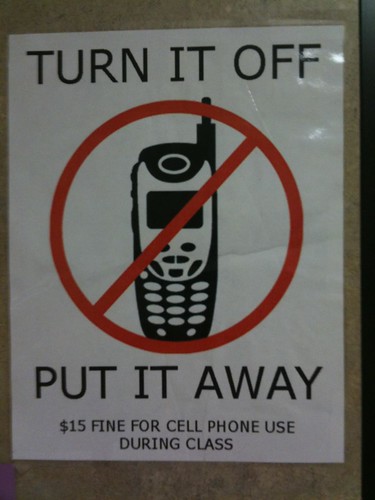
The story plays on educators’ worst fears – laziness, lack of student attention, fighting against social media, “addiction” to tech. They’re tropes, and the pouches are a novel iteration of signs like the ones below.$15 fine for cell phone use during class

The story also misses an opportunity of the sort outlets like NPR pride themselves on – having the better conversation. In improvisational theater, it’s called moving from A to C. At some point in her reporting, Smith says:

DeCopain says students are more engaged, and some are starting to see the virtue in the pouches – sort of.

The “virtue of the pouches”? Aside from what I hope will be the title of an animated film about world-saving kangaroos, this is where the story misses an opportunity. In these 5 minutes, there’s no mention of the virtue of helping students self-regulate, there’s no mention of the virtue of teachers leveraging the fact students are bringing their own computers to class, and there’s no mention of the virtue of teachers considering how these devices make questions like the featured practice problem “X to the third power minus 13-X” exceedingly irrelevant (if they ever were).

The only counterpoint the story is Cal State’s Larry Rosen warning restrictions like the pouches could inspire “massive anxiety”, because children are fragile. Rosen’s suggestion of “tech breaks” further paints the picture that smartphones only serve as a distraction and have no practical use in the classroom, an argument we should be done making at this point.

My entire experience listening to the story, all I could think was, “This is completely letting teachers off the hook from improving their practice as professionals in modern schools,” and “We’ve found another way to make schools like prisons.”

I’m not so ignorant as to expect edtech stories (pouch stories) like this won’t get picked up by even the most reputable of news organizations. I’m not yet willing to let go of an expectation of full, thoughtful, balanced reporting when a story has many perspectives.

Kangaroo standing in a clearing
Photo by Mark Galer on Unsplash


My Best Moment of the Week: Defying Expectations (12/365)

high jump mattress

It was a third grade classroom, and I was part of a team of folks walking through and looking for evidence of something or other. The problem with asking me to enter a classroom of students as an observer is my predilection to thinking kids are pretty amazing and worth conversing with.

“What are you learning about?” I asked a little guy toward the front of the room.

“Did my teacher send for you to come get me?”

It took all of three seconds to read the situation. Broken fragment of a pencil, nothing written on his paper while his classmates were at least half a page in, grimace on a face that’s wondering just how many shoes life has for the dropping. I’d inadvertently joined a slow-boil freakout just as it was reaching a simmer.

“I don’t even know your teacher, I am just here because I’m curious what you’re all working on. Oh, man, your pencil’s broken. Here’s my pen. Huh. I don’t know how to do this problem on your paper here.”

“Do you teach here?”

“I work in all of the schools.”

“What do you teach?”

“I’m an English teacher. It’s been a while since I’ve done some of the math like what’s on your paper. Will you help me remember how to figure these things out? Unless you don’t know how to do it. If you don’t, that’s cool. I bet we could figure it out.”

“Um.”

“Like this one, how would you figure this one out? It doesn’t look like a usual math problem…”

“Because it’s algebra.”

“Oh, what’s that mean?”

“Like, you just…” and he kept talking and explaining. The grimace retreating to the corners of his mouth, his shoulders lowering, examining my pen, doing a poor job of hiding his enjoyment of using a green pen to do math.

The exchange took 4 minutes. The unintended de-escalation wasn’t fueled by anything other than wanting this student to understand I wasn’t the adult he expected me to be.

More often than I’d expect, my work includes being happier and sillier than students expect. I’m consistently taken aback in the powerful trust we can build with students when we show them we are willing to listen.

That’s the opportunity each of us who has the privilege to working with children has each day. We get to change expectations by raising expectations. We get to throw joy where anger or apathy is expected. We get to be kind.

We have the exceptional challenge every day of being better versions of ourselves every day than our students expect us to be.