Things I Know 278 of 365: UncommonGoods and Etsy are goto sites for teacher gifts

Over the next few weeks, I’ll be making some suggestions of possible sources of gifts for the teachers in your life. Some will be products for purchase. Some will be ideas of things to make. All of them will be meant to help remember teachers as worthy of thanks.

I’m a fan of the unusual, useful and responsible. If I can find all three in a gift, I go for it.

Two online sites can be counted upon to give me options in this regard – uncommongoods.com and etsy.com.

Here’s what defines UncommonGoods apart:Shopping either site for a gift for a teacher will head you in the right direction.

Featured Artist: UncommonGoods highlights the stories of our artists and designers throughout our website as well as our print catalog.

Handmade Goods: Look for the blue hand icon throughout the website to find our handmade goods.

Uncommon Knowledge: UncommonGoods posts surprisingly uncommon information and facts related to certain product categories or featured items on the site. For example, did you know that early candles were often eaten rather than burned? Or that Leonardo da Vinci invented the scissors?

Our Commitment to the Environment: UncommonGoods strives to work in harmony with the environment: our print catalogs are printed on recycled paper (30% post consumer waste) and all our merchandise is produced without harm to animals. Look for the green recycled icon throughout our website for products made of recycled materials.

Better to Give Program: We donate a portion of each order to your choice of non-profit organizations: American Forests, AmeriCares, City Harvest, and the Rape, Abuse & Incest National Network (RAINN).

And Etsy:

Our mission is to empower people to change the way the global economy works. We see a world in which very-very small businesses have much-much more sway in shaping the economy, local living economies are thriving everywhere, and people value authorship and provenance as much as price and convenience. We are bringing heart to commerce and making the world more fair, more sustainable, and more fun.

Both Uncommon and Etsy had the added benefit of supporting creative communities and independent artisans. Each time I make a purchase from either site, I have the feeling I’ve just purchased a gift that will be unique and special to the individual for whom I’m shopping.

The range of prices on both sites allows for diversity of choice without getting too spendy, and I’ve never felt as though my purchase was anything less than high quality.

Any gift for a teacher from UncommonGoods or Etsy has the added bonus of sending the message that you see the teacher as unique to your or your kid’s education. And that’s a message worth sending.

Things I Know 277 of 365: Parent conferences can be student conferences

It is critical that both parent and teacher know that the goals for the child are indeed shared goals, both teacher and parent want what is best for the child/student.

– Sue

Twice each year, the folks at SLA sit down with their advisees and their advisees’ parents and have a discussion of each student’s progress. It’s not an unfamiliar process, but the structures at SLA are different than those I’d experienced in any previous schools I’d attended or taught in.

Growing up, my parents would disappear two nights each year to meet with my teachers.

Upon their return, we would all sit at the kitchen table where my mom would work teacher-by-teacher beginning each review with, “What do you think she had to say about you?”

A torturous process in the moment, I see now what she was trying to do and the habits of mind she was attempting to build.

Last year, at SLA, I felt as though I’d finally gotten my vision of these conferences to line up with the actual practice.

The key was to prep our advisees as much as possible. In years prior, I’d told my advisees they would be responsible for leading the conference discussions, but failed to give them adequate practice in anticipating what they might want to say and how they would make the conversations run as effectively as possible.

How would they steer their parents clear of obsessing over the one low grade to the exclusion of the other A’s and B’s? If the narratives and report cards fell short of their own explanations, how did they plan to reverse course in subsequent quarters?

I’d forgotten my time and training as a teacher had provided me with myriad ways to navigate these waters.

Childhood, adolescence and schooling had provided my students with two strategies – But mom… and (silence).

Neither proved tremendously effective in fostering a discussion or ownership of learning.

Diana asked me earlier today if I had written anything about what made last year’s conferences so successful. I hadn’t. Here it is.

  1. My co-advisor Matt Kay and I showed our advisees both their report cards and narrative report cards in the advisories prior to the conferences. We asked them to compare the grades on the report cards with the comments from the corresponding teachers’ narratives. What did they notice? What surprised them? What made them feel seen? What did they want to highlight with their parents?
  2. Each advisee filled in a table with columns labeled, “What I want to stay the same,” “What I want to change,” “How I’m going to change it.”
  3. Looking at their report cards, their narratives, and their tables, our advisees planned the flow of their conferences. Matt and I offered guiding questions. Would it be better for your parents to hear disappointing news earlier or later? Does it make more sense to show your report card before your narratives or the other way around?
  4. Once it was planned, we asked one student to volunteer for a mock conference where two other advisees played the parents. The rest of us watched. After the mock conference, the whole advisory debriefed and reflected on possible topics or situations we saw that might come up in their own conferences and how they could be approached.
  5. On the day of the conference, the students were the leaders. Matt and I had digital copies of the narratives and report cards, but we kept mum. The entire time, my internal monologue was, “Shut up, Zac. Your only job is to support.”

When all was said and done, I saw more student ownership and parent-child conversation along with teacher restraint in last year’s conferences than any others I’ve been a part of.

How do you conference?

Things I Know 276 of 365: #ThingsThatNeedToEnd

I’ll get to things I’m thankful for tomorrow. Tonight, twitter’s trending with #ThingsThatNeedToEnd and a few popped into mind.

  • Talking and calling it conversation.
  • Not saying anything and calling it listening.
  • Walking by the person on the street asking for change because you’re sure they’ll just spend it on alcohol, but never donating a dime to your local homeless shelter or food kitchen.
  • Assuming.
  • Requiring people to take their shoes off at airport security.
  • The Bachelor.
  • Calling schools failing and then asking them to muster momentum to improve.
  • Illiteracy.
  • Abuse.
  • Fast food.
  • Pay inequity.
  • Anything that would lead a kid person to feel less than.
  • Talking about teachers as though they aren’t trying or don’t care.
  • Talking about students as though they’re incapable of learning and creating amazing things.
  • Admiring the problem.
  • Fracking.
  • Complaining that social networking is keeping people from truly connecting, while still remaining silent in every elevator.
  • Seeking the one silver-bullet answer.
  • Claiming you’ve got the one silver-bullet answer.
  • Taking ourselves so seriously.
  • Calling anything that highlights a difference we don’t understand or wish didn’t exist “the X gap.”
  • The McRib.
  • Teaching by telling instead of showing.
  • Feeding students anything other than the best possible food for lunch.
  • Marketing electric cars while completely ignoring the source of most of America’s electricity.
  • Leading with anything other than a question.
  • Asking, “How are you?” with anything other than the utmost sincerity.
  • Letting others do the heavy lifting.
  • Subscribing to a belief in the importance of caring for the least among us and then denying them access to health care.
  • Comparing anything that’s not actually Hitler to Hitler.
  • Treating the symptom while ignoring the problem.
  • Expecting more from people without giving them space and resources to grow.
  • Ignoring the value of personal experience.
  • Valuing personal experience as though it is representative of the group.
  • Daylight Saving Time.

Things I Know 275 of 365: I’m from around

You can’t go home again because home has ceased to exist except in the mothballs of memory.

– John Steinbeck, Travels with Charley

A friend of mine was explaining her family’s Thanksgiving spread the other day, “We’re Italian,” she began and then described the menu.

It got me thinking about how I would start that explanation. My forebears got around. While I’ve always had a twinge of jealousy toward friends who can trace their lineage to one or two countries, I’ve also felt a sense of pride when I explain my mixture of heritages.

I can certainly take it back to pre-American roots and examine the tour of Europe. I don’t feel tied to those countries though. Growing up, there were no traditions rooted in my German or French ancestry. No big family meals featured foods of a specific culture on the table.

My most immediate sense of where I’m from comes from where the last five generations of my family found their homes. The Oklahoma Territory, Colorado, Missouri, Illinois. These places signify the geography to which I find myself most attached. They are where I consider myself to be from.

My dad, grandparents and great uncle live in houses dotted on what, a generation ago was our fully functioning family farm. Rusting on a sign post along the road is a sign, now nearly 20 years old, certifying the land as a sesquicentennial farm. Before it was the Land of Lincoln, and not long after it became a state, Illinois was the place of my people.

A stone in my dad’s back yard bear’s a plaque noting where my ancestors built their first cabin upon arriving in Illinois.

While my roots are somehow in the soil of far-off lands, it is in these more local spaces that I feel most planted.

Some friends took a year or a summer abroad after graduating college. They backpacked through Europe and got to know the cultures and history of spaces unknown.

To me, this is odd.

Much of this country to much of its people is made up of spaces, histories, and cultures unknown.

A person could travel from Chicago to Birmingham or vice versa and find they’ve crossed tremendous boundaries.

This is lost on many.

We speak of America as a monolith, which is what I suppose comes of naming them the United States.

The paradox of it, though, is the pluralism of our unity.

Often I read of schools whose missions are to take their students to several countries or continents before they graduate.

Think of the education possible in the goal of ensuring all students visit each of the 50 states before they graduate. They would graduate not only with a high school diploma, but with a certificate in advanced citizenship as well. They would carry with them an understanding of the complexity of democracy few could match and one sadly lacking in much of our national discourse.

The threads that tie me to my ancestors of other nations are gossamer. Those that tie me to where I’m from are those that matter most.

Things I Know 274 of 365: Letters make great teacher gifts

The deepest principle in human nature is the craving to be appreciated.

– William James

Over the next few weeks, I’ll be making some suggestions of possible sources of gifts for the teachers in your life. Some will be products for purchase. Some will be ideas of things to make. All of them will be meant to help remember teachers as worthy of thanks.

It sits on the shelf in my bedroom – a manilla folder that should be a box, but whose contents I haven’t taken the time transfer. The tab of the folder bears the faded name of a former student, but the work inside isn’t his.

If I were to give it a name, I’d go with something like, “The Good Stuff.” This is the folder that holds the notes and letters received from students over the last eight years. I don’t have them all, but I have enough.

When I was teaching, this file lived in a drawer in my classroom. On days when I felt like the last thing I should be doing with my life or to the lives of my students was teaching, I’d flip through it and convince myself there must be some good there.

The folder inspired my annual end-of-year assignment that asked students to write a letter to a teacher who had inspired them giving an update on their lives and letting them know the impact their teaching made.

The folder is also what inspires my recommendation for a holiday gift for a teacher. Write a letter – a real letter – letting them know the effect they’ve had in your life or your child’s life. The only thing it will cost you is time, but it will be more valuable to the receiving teacher than you can know.

Take it a step further, write a letter of appreciation about the teacher and send it to the principal.

One of my favorite parts of having my students write their inspiring teachers was the chance to write letters to my own. Even if you are not a student or the parent of a student, consider giving the gift of a letter of appreciation this year to a teacher who’s made a positive impact in your life.

I know from experience how much those letters can mean and how their contents can sustain us in moments of doubt.

Things I Know 273 of 365: Value added isn’t

Value-added assessment is a new way of analyzing test data that can measure teaching and learning. Based on a review of students’ test score gains from previous grades, researchers can predict the amount of growth those students are likely to make in a given year. Thus, value-added assessment can show whether particular students – those taking a certain Algebra class, say – have made the expected amount of progress, have made less progress than expected, or have been stretched beyond what they could reasonably be expected to achieve.

– The Center for Greater Philadelphia

Professor Andrew Ho came and spoke to my school reform class tonight about the idea of value added and its space in the conversation on American education.

We started looking at a scatterplot of local restaurants situated by their Zagat rating and the Zagat average price per meal.

Ho then plotted a regression line through the scatterplot and took note of one restaurant that had a higher score than predicted for it’s cost.

The temptation was to claim our overachieving restaurant was a good buy for the money. Who’d expect a restaurant with such inexpensive food to have such a high rating?

Then he asked us what we didn’t see.

Portions, ambiance, quality, location, service, selection, etc.

Any of these is familiar to someone who’s debated with a group of friends when attempting to select a restaurant.

His point was simple. Expectations changes based on what you base expectations on.

Ho relabeled the axes – this year’s test results, previous year’s test results.

He asked us what we didn’t see.

Content, delivery, socioeconomic status, race, home life, sports, after-school activities, tutoring, mentoring, etc.

This is to say nothing of the fact that perhaps there is a natural spread to knowledge and growth that is beyond the influence of a teacher or the fact that different combinations of teachers in the life of a student in a given year could have varying effects on achievement.

A psychometrician, statistician and policy researcher, Ho then laid some data on us from the research on value added:

  • Estimates of value added are unstable across models, courses that teacher might teach, and years.
  • Across different value-added models, teacher effect. ratings differ by at least 1 decile for 56%-80% of teachers and by at least 3 deciles for 0%-14% of teachers (this is reassuring).
  • Across courses taught, between 39% and 54% of teachers differ by at least 3 deciles.
  • Across years, between 19% and 41% of teachers differ by at least 3 deciles.

He then made a point that’s come up time and again in my statistics course, “Any test measures, at best, a representative sample of the target domain.”

But we’re not seeing samples that are representative. According to Ho, “In practice, it is an unrepresentative sample that skews heavily toward the quickly and cheaply measurable.” We’re not learning about the population. Put differently, we can’t know all that we want to know. Anyone who says differently is selling something.

When questioned on teacher assessment in his recent Twitter Town Hall, Sec. Duncan said he favored multiple forms of assessment in gauging teacher effectiveness. Nominally, Ho explained, this makes sense, but in effect it can have unintended negative consequences.

Here too, Ho cautioned against the current trend. Yes, value added is often used in concert with observation data or other similar measures. If those observations are counted as “meets expectations” or “does not meet expectations” and all teachers meet expectations, though, we have a problem. The effect is to mute the impact of this measure in the composite. While it may be nominally weighted at 50%, if value added is the only aspect of the composite accounting for variance, “the contribution of these measures is usually much higher than reported, as teacher effectiveness ratings discriminate much better (effective weights) than other ratings.”

Ho’s stated goal was to demystify value added. In that he succeeded.

He left us with his two concerns:

  • The current incentive structures are so obviously flawed, and the mechanisms for detecting and discouraging unintended responses to incentives are not in place.
  • The simplifying assumptions driving “value added,” including a dramatic overconfidence about the scope of defensible applications of educational tests (“numbers is numbers!”), will lead to a slippery slope toward less and less defensible accountability models.

I’d hate to think we’re more comprehensive in our selection of restaurants than teacher assessment.

Things I Know 272 of 365: Sketching a school brought clarity of practice

Architecture aims at eternity.

– Christopher Wren

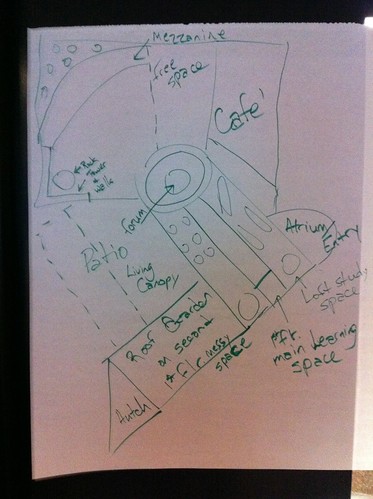
Tonight, in preparation for our next learning task, the class was asked to think about the physical design of a school or learning organization.

What would it look like?

On the heals of drafting our theories of learning and how we might design for difference, this learning tasks makes sense.

It’s also right up the alley of thought I’ve been strolling down recently. Design has been on my brain.

Interestingly, when the professor gave us time to play and told us to see what we could come up with in sketching out what our schools would look like, I had no previous experience to draw from.

I’ve spent the last 8 years re-tooling, rearranging and rethinking classroom design. For the last 6, I’ve been thinking heavily about the systems, structures and pedagogy that work best to the good of the children and adults in schools.

If you asked me what I thought it would look like to see teachers and students interacting in these environments, I’d rattle off words like caring, collaborative, curious, reflective. Then I’d pepper it with examples from my own experiences.

The thing I haven’t done, that I hadn’t done until tonight, is sit down and sketch out what the physical structure of that place might be.

Part of that is likely tied to the fact that those in schools rarely get input into the spaces in which they teach and learn. Often, it’s a rehabilitated building or one that’s been around for decades. To design the physical space is a rarity.

I doodled for a bit tonight, playing with shapes and trying to piece together the structures I’m drawn to and where my students have told me they learn best.

More than anything, I wanted a set of LEGOs. The paper didn’t do what I wanted it to. I needed something bigger and more malleable.

Just before time was called, my group asked me to piece all of our sketches together for a composite final product. You can see it below.

What I said to me team, and what is still true, was that this space is a place I’d both want to teach in and send my kids to.

And that’s just one the first try.

I wonder what would happen if teachers took five minutes to doodle their ideal teaching spaces and then worked to teach as though they were in those spaces. I wonder what would shift. I wonder how interactions and expectations of the students would change.

I wonder what they would sketch with their practice.

Things I Know 271 of 365: Innovation takes both less and more

Imagine once more, I said, such an one coming suddenly out of the sun to be replaced in his old situation; would he not be certain to have his eyes full of darkness?

– Plato

While the reading in grad school is just as ridiculously intense as promised, if I time it properly, I can still be curator of at least a small sliver of my reading diet.

This morning, heading out the door, I picked up a copy of William Glasser’s The Quality School. I’m not sure where I got it, but it was on my shelf.

Early in the book, Glasser writes, “We should keep in mind that the power of innovation is not that it increases the number of innovative people but that it gives the effective people we have a better chance to demonstrate their effectiveness.”

The quotation struck me as tweetworthy (and given the tonnage of reading I’ve been doing, that bar is high).

Joan Young responded, “That quote makes me wonder how many innovators lie dormant in settings that don’t foster creativity. Thanks for making me think.”

John Spencer jumped in, “I agree. And yet creativity often thrives because of the limitations, barriers and restrictions of a context.”

The conversation turned to the allowances afforded by limitations. Young commented she had arrived at her most creative solutions when confronted with distinct limitations.

This makes sense to me. It echoes the sentiment of last year’s EduCon Friday panelists.

Innovation, the panelists seemed to contend, comes from the intersection of necessity and limitation.

I don’t contend this is untrue, but it can’t be the only path to innovation. Or, they aren’t the only necessary ingredients.

When I think of spaces where creativity and innovation can thrive, I think of the playgrounds of my youth. Before everything was safety-coated, they were spaces of steel, wood and gravel. If you squinted, they looked like residential construction sites.

For my friends and I, they were castles, pirate ships, mansions, and underground lairs.

Our resources were certainly limited. I’d also argue our excess stores of energy necessitated building some sort of imaginary worlds.

There weren’t the only pieces that let the playgrounds become whatever we wanted and needed them to be.

Two other factors cleared the way for our imaginations.

Our parents were nearby, watching from the periphery in case someone got hurt, but otherwise refraining from interference. They needed to be their for their own piece of mind, and we needed them there in case we got in over our heads.

We also needed one another.

These were our first moments of collaboration. We were writing the rules of the game. Where I saw a castle, another might see a space ship.

Because of our limitations of space, our necessity of play, the safety provided by our parents’ watchful eyes and the want to play with another, we settled on a space castle.

And that was the beauty of the recipe. We didn’t know what we couldn’t do, so we did it.

Gradually, our parents increased their perimeter and we became more responsible for ourselves. Unfortunately, this also led to access to more resources. While they weren’t castles or space ships or space castles, they were new and shiny.

I sometimes wonder about the guy in Plato’s “Allegory of the Cave.” I’m certain, after seeing the light and the forms of things, he had to wander back home. With all he’d seen, I still imagine him working some cave Thanksgiving to see what his family saw dancing across the wall.

“Oh, look at that fernodan!” someone must have said.

“There’s no such things as a fernodan,” I bet he said.

How they must have laughed at him.

Things I Know 270 of 365: Blissmo boxes make great teacher gifts

Over the next few weeks, I’ll be making some suggestions of possible sources of gifts for the teachers in your life. Some will be products for purchase. Some will be ideas of things to make. All of them will be meant to help remember teachers as worthy of thanks.

A few weeks ago, a small cardboard box showed up at my door. While I didn’t know what it held, I knew from whence it came.

It was my first blissmo box, and I recommend it for your consideration as a gift for a classroom teacher.

The Basics:

  • for $19 US each month, you choose from one of three themed boxes curated by the folks at blissmo
  • each box is filled with between $25-$50 (or more) worth of merchandise
  • the products are “either certified as organic or eco-friendly, or that have a people & planet positive approach in the DNA of the business”
  • either keep all the products for yourself or hand them out to your friends as gifts

I was gifted 3 months of blissmo boxes by a friend, and I loved the first one. Guest-curated by the folks at Good, it included:

  • a $25 gift from PACT underwear (I used it on socks)
  • a miir water bottle ($1 of each bottle sold “provides one person with clean water for one year)
  • organic, small-farm-grown tea from the folks at runa
  • a set of To-Go-Ware bamboo utensils in a pouch made from upcycled plastic bottles (it lives in my backpack and has already saved me from using at least 10 sets of plastic silverware)
  • a 3-pack of notebooks from Scout Books made of 100% recylced paper, printed with soy ink and sourced from local paper mills (think eco-responsible moleskins)

I was a little worried I wouldn’t dig every item that showed up. My worry was misplaced. You can gift a blissmo box here or sign a recipient up directly here. While my thinking is running along the lines of teacher gifts, these would be a great monthly care package for college students as well.

Things I Know 269 of 365: I’ve got an idea for disrupting PD

The highest possible stage in moral culture is when we recognize that we ought to control our thoughts.

– Charles Darwin

I’m working to understand a framework for professional development and capacity building that disrupts traditional thinking and builds toward the type of risk-ready culture Richard Elmore describes and of which I was a part at SLA. In the simplest of terms, it’s a culture of responsible citizenship and stewardship for the educational community. Several different ideas have been influencing my thinking.

The first was the idea of the “Chinese restaurant” approach to “spreading” an educational model described by Charles Leadbeater in his TED talk. Not everything looks the same, but you know when you’re in one. For me, the idea of a coffee shop works best. They are places I seek out, that “pull” me as Leadbeater said, and invite me to stay longer than I intend. It’s got me thinking how one could design a space (physical or virtual) where this is the reaction of those students and teachers who are part of the community.

As my studies returned me to our thinking on “the instructional core,” I started to think about a recent Forbes interview with Don Tapscott. Describing the path to “Enterprise 2.0” and a looming crisis of patent expiration in the pharma market, Tapscott said, “You need to change the whole modus operandi of the industry and how you do research. They need to start sharing science and sharing clinical trial data… The current model is unsustainable, even if it didn’t happen to be coincidentally all coming together over a cliff.” I’ve started to wonder if pharma’s cliff is near education’s cliff.

In many ways, this strikes me as the path to the type of interaction and capacity building Richard Elmore writes about. It also seems a fair way for inspiring risk-taking he mentions. This is a similar idea to that of KIPP Open Book, a project of Philadelphia’s KIPP schools meant to make their data and practices more transparent. It’s an example of system-level transparency of practice, that could potentially influence the transparency of teachers and students, though it would likely require a substantial shift in pedagogy to allow for the agency required for teachers and students to feel more comfortable to take risks associated with such transparency.

This returns me to the question of how I would build a culture comfortable with risk-taking and responsible citizenship to increase capacity and align our practice with a goal toward improvement. To the extent possible, I’d hire the “right” people. At Science Leadership Academy (SLA), each interview committee included the principal, teachers from the department with the open position and at least one student and one parent. These committees were formed ad hoc. Though the principal maintained final say, I cannot recall an interview where the final decision differed from the consensus of the committee. This practice was built into the culture of the school. Oftentimes, students were the first to speak up in deliberations to point out that a particular candidate was a poor fit for the school. In my own practice, I would adopt a hiring approach similar to if not the same as SLA’s.

As to the question of professional development, I’m tempted to stray further from the norm and suggest a rotating position of Professional Coach. Each year a different teacher would assume a reduced course load to work with the school’s leadership team as the director of professional development. The role would entail observations, leading PD around the school’s improvement goals and helping to research particular issues of practice in the coach’s own classroom. The position would last a year, after which, that teacher would return to a full load. Other teachers would submit their names (and perhaps an application) for the following year and the leadership team, whole faculty, or principal would select the next year’s Professional Coach. Again, it’s an idea I’m toying with, and I’m still working to conceptualize the possible impact on school culture.

The thing I want to know is this, how can we prevent the standard testing accountability measures from being the tail that wags the dog of professional development and setting the definition of improvement?