36/365 Turning a Snow Day into a School Day (a guest post)

Paul Tritter is a friend and Boston school teacher who found himself up against some deadlines in the wake up Nemo. I asked him to share how he pulled the majority of his students into an impromptu online course to keep momentum moving.

You might have heard that we had a little snow storm up here in Boston last week.  I love snow. Nothing creates neighborhood camaraderie quite like the morning shovelling after a big blizzard, and as a teacher, I love a snow day or two. The unexpected time to relax (i.e. catch up on grading and planning) is always welcome. School was cancelled Friday, and the call came Sunday that we would be out Monday as well (eventually we missed Tuesday too). At my school we have half-days scheduled for Wednesday and Friday, and school vacation is next week. Lots of time off.

As any teacher knows, this is a little bit too much time off.  Momentum in a classroom is hard to develop and maintain, and all of this stopping and starting is not going to be much help.  This interruption is going to be felt most acutely by the seniors in my IB Literature course. Those who are familiar with the International Baccalaureate (IB) Diploma Programme, will know that students in the second year of their literature courses are about to run up against a series of internationally determined deadlines for various rather high-stakes assessments. The dates won’t change, and I’ve just lost three days.

In my class, the students are preparing for the sin qua non of IB assessment, The Literary Commentary.  For this assignment, students are given a poem with which they are familiar, but that they have not studied in depth during class time. They do not know exactly what poem they will be given until they arrive in a room and are presented with a stack of envelopes each containing a different work.  The student is given precisely 20 minutes to prepare an 8-minute commentary (known in French as an explication de texte) on the poem. The commentary should have a central argument that is more than just an interpretation of the poem.  Students must walk through the poem identifying and explaining the various literary devices, authorial choices, and writer’s moves, explaining the effect of each, and discuss how it contributes to the overall meaning or effect of the poem. The 8-minutes is followed by two minutes of Q&A and then a 10-minute conversation about another work that we have studied in the course.
The commentary is conducted one-on-one with the teacher, recorded, and sent to IB for external assessment.
It’s stressful, and it’s hard.

The primary aim of my teaching in the unit leading up to the commentary is to get students to unlearn one of the nasty habits of reading poetry, reflexive interpretation. In the commentary, and in reading poems in general, it is important to first focus on the literal, to be able to notice and articulate what is on the page, that which is indisputably true.  There is a temptation to make the first question after reading a poem, “What does it mean?”  But in an exercise like the commentary, and really in developing any good reading of a poem, the first order of business must always be to ask, “What is there?” or “What do you notice?” This way, students are asked to slow down their thinking and make clear what precisely in the poem leads to their overarching interpretation of the piece.

There are lots of ways to get at this particular skill of noticing, but nothing so effective as consistent practice, and all of these schedule interruptions are not going to be helpful in this process.

So I had an idea. I would try to get together an impromptu online class for my students on the snow day.

While shovelling, I checked in with some high school kids in my neighborhood who told me that they would probably not participate in such a thing unless there was extra credit involved.  I usually have a “no extra credit” policy, but I was kind of curious to see what this would look like.

I posted a note on our class edmodo site offering the bonus and asking for interest.  Twelve of the nineteen students in the class expressed interest.  Great! But I hadn’t really thought through how I would go about running the class, and as I continued to think about it, I came up with more and more problems.  Here are the main ones:

  1. I needed a free or cheap platform through which to conduct the class.
  2. The work and learning of the class needed to be completely extra-curricular. Because this was optional and dependent on using technology that all students may not have readily available in their homes, I couldn’t assign any of the material that would be required for my class.
  3. The learning needed to be meaningful, but the agenda not overly ambitious for an experimental venture.

Solution #1:
Through a quick tech consult with Zac, I decided it would be best to use a hangout on Google+, even though they are limited to 10 participants.  I would livestream the hangout for overflow participants and set up a backchannel for chatting and linking. While this was not ideal, it would work well for the experiment. I would use a google doc to capture the student work.

Solution #2:
I had planned at some point to read this article about poetry and meaning with my students.  In it, the writers examine an example of found poetry created from Craigslist Missed Connection posts, and essentially provide a commentary on the poem. It is to some extent a professional model of the work I am asking students to do. With the condensed schedule, I wasn’t going to be able to cover it in the depth I wanted to, or do the activity I was planning, so I decided to use its premise as the basis for the lesson. I figured that students sitting at their computers during the lesson would have ready access to source material to turn into found poetry. It occurred to me that I should not ask my students to go onto Missed Connections, so I had them use their own Facebook and Twitter feeds as source material.

Solution #3:
The focusing question for the lesson was: What makes a poem a poem?

Here were the basic steps.

  1. Students would look through their social media feeds and find one post (ideally fewer than 50 words) that was striking or interesting in some way and paste that post to the google doc I had set up for the class.
  2. We would scroll through the document and have each student read his or her post and say why they picked it.
  3. Students would make a second copy of the post and, without changing any words or punctuation, turn it into a poem.
  4. Students would read their poems, and then verbally and in writing explain what they did to turn the post into a poem.

The idea was to get students to notice and articulate the choices they were making that made their selected post become a poem. My thinking was that if they could see themselves turning everyday prose into poetic language, they might be more attuned to the types of moves that poets make in the texts we will read in class.

What happened.

The biggest challenges ended up being the technical ones. I am not in the habit of making friends with my students on social media, so I created a new Google+ account just for this purpose.  Students had trouble finding it, and some of those who had not used the site before found it confusing and less than user-friendly (I am with them on that. I never use my Google+ except for hangouts.)  By the time we were ready to get started, 11 of them had found and added me and two more were trying to.

I decided not to spend a lot of time delaying the hangout to deal with these difficulties because it was, after all, an experiment.  By the time we really got started, I had eight participants. Good enough.

The real problem was my computer. For some reason, I was unable to get my microphone to work. I unmuted everything. I tried the built-in and an external mic, but no matter what I tried, I could not get my students to hear me (What else is new?). I debated cancelling the session, but instead decided to press on using the chat feature in the hangout.  This was slow-going, but I was able to copy and paste some of the notes I had written in my rough lesson plan, and one of the students kept reminding the others to look at what I was typing. It was not ideal, but it went well.  This created the most problems near the end when I was trying to get students to clearly articulate their rationales and begin to develop interpretations of their poems. It was just taking too long to type everything.

When all was said and done, we had been on the chat for nearly two hours. Though I think the work could have been a little bit better in quality, it wasn’t bad for a snowday lesson under technical duress.  Some of the student observations included:

  • I found two words that rhymed and put them at the ends of lines.
  • I put a word by itself on a line to add emphasis.
  • I put the word “small” by itself on a line to be a physical representation of the meaning of the word.
  • I added line breaks where I thought the tone of the original changed.

(Note:  Once I get all of the students’ permission, I will post the document we created.)

These comments and others were exactly what I was after from the lesson. Had we had more time (or any audio) I might have encouraged them to develop more complete interpretations of their poems, but I was happy with these outcomes.  Students were articulating the types of features that make poems poetic. Now we’ll see how this transfers to our actual classroom work and whether, having created poems themselves, the student will be more attuned to the choices of the poets we study.

Here are some of my takeaways from the experience:

  1. Despite the hassles, the students thought it was fun.  Several said that they wish we could have online class more often.  I think it was critically important that this was an interactive forum rather than the one-way types of online courses that pervade. We learned together.
  2. I spent a lot of time setting this up.  In the future, I might make the basic setup of a system like this a part of my beginning of the year routine. That way, when such a situation arises again, I won’t be running around the internet like a chicken with my head cut off (or a teacher who forgot to make copies).
  3. Not being able to talk is not the worst thing in the world.  One of the main goals in my practice this year is to talk less in classes and have students talk more.  I’ve been doing a pretty good job of it, and this was a natural extension of that work.
  4. Pedagogy matters more than technology does. A lesson has to be uniquely tailored to the students and the context. This was an Arthur C. Clarke experience, and I think I’m safe for now.

Questions that remain (and I’d love to hear your thoughts):

  • Has anyone else had similar experiences?  I’d love to hear your stories.
  • Which platforms might be better for something like this?
  • I have heard and read several news stories of teachers and districts doing similar things. Should this become a regular practice in our schools? If it does, how do we account for the lack of access to technology in many of our students’ homes?
  • A pedagogical question: I considered asking the students to choose source material that they found poetic even though it was not a poem. I opted to simply have them choose any post they found interesting on the theory that any interesting text has some qualities that could be considered poetic and thus be enhanced by the poetic form.  My concern was that by introducing the idea that the the language should be poetic too early in the process, they would later be less aware of the specific choices they had made to turn it into a poem. Would this alternate phrasing of the original task have changed the final outcome?  If so, how?

Thanks for reading, and thanks Zac for the forum.

Paul tweets at @ptritter.

Learning Grounds Ep. 008: In which David talks about moving to what’s next and what’s key to his learning

In this episode, Zac sits down with David Bill to talk about what’s moving him from a formal school setting and what he’s moving toward. We discuss his passion for authentic learning and where it originated.

Play

34/365 My Four Rules for Conference Session Attendance

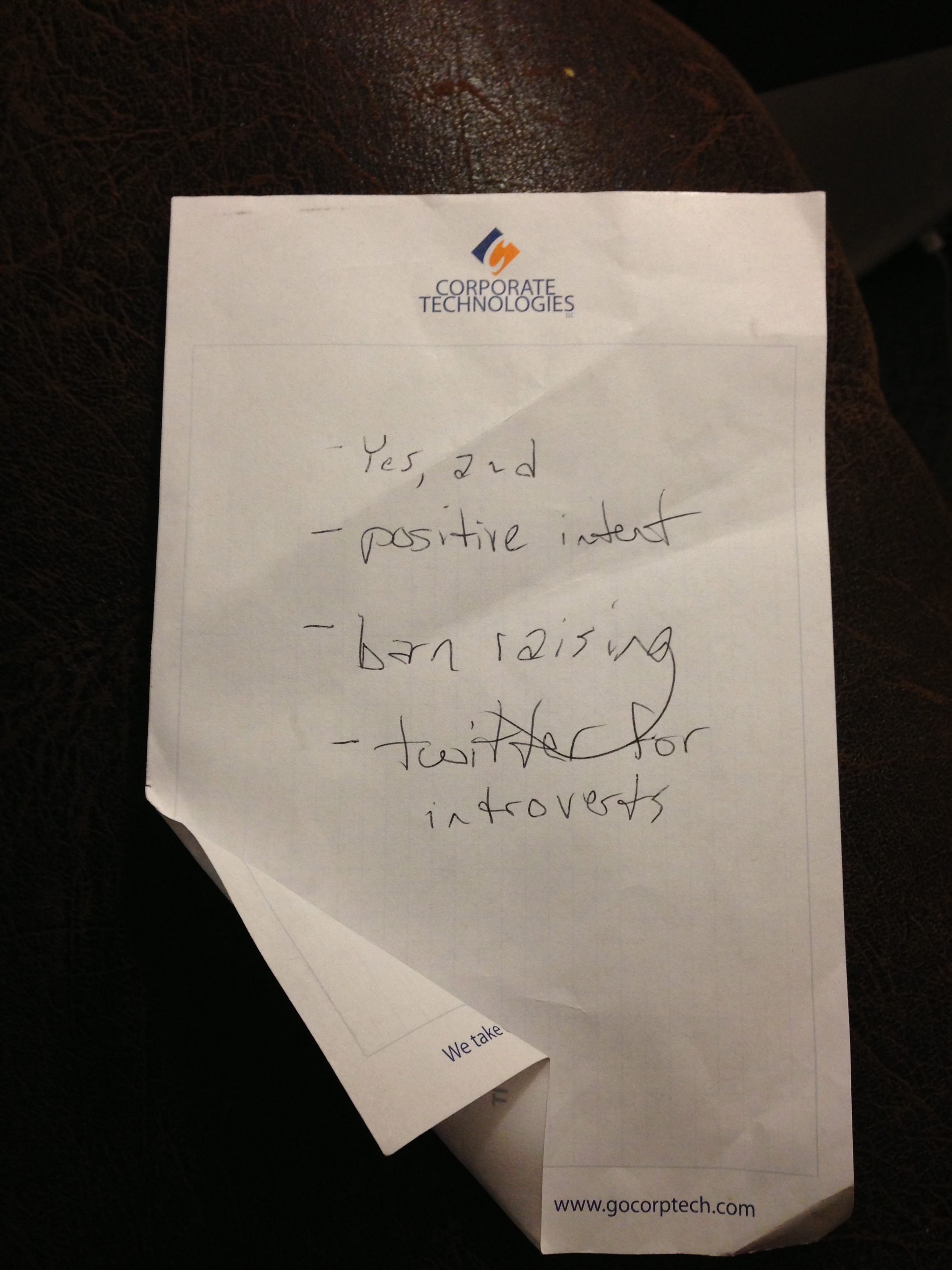
Before my second session at IETA, ran to the vendor hall to snag a pad of paper. I’d rushed in to my first session without laying down some ground rules, and figured writing them down would help me to remember to say them aloud this time. The photo below are the four rules I count as key to positive conversations where learning is involved.

four rules

1. Yes, and…
It’s a key to improv, and experience has shown it to be a key to getting anything done that might look like a solution. If you’ve ever spoken to a group of teachers (or any other group of adults in a system who’ve grown accustomed to how things are done), you know the tendancy of a momentum-killing phrase to pop up, “Yeah, but…” By asking folks to agree to a mindset of “Yes, and…” for at least 90 minutes, you’re able to stave off comments that sound a lot like, “Yeah, that’s a great idea, but here’s why it won’t work in my school…” Instead, “Yes, and…” asks participants to approach new ideas from the perspective of, “Yes, that’s a great idea, and here’s how I’d have to modify it to work in my school…” If I can get people to agree to this line of thinking for the 90 minutes, it’s possible we might get some actual work done.

2. Assume positive intent.
My friend Mike believes what he believes. At the same time, he’s willing to hear other people out and change his mind if the argument makes sense. “I always assume positive intent,” he told me at the beginning of the year. “Even if I disagree completely with what other people are saying, I assume they’re coming from a positive place.” It was the first time I’d heard the idea put in such a way. It was more adult and less Pollyanna than, “I look for the best in people.”
When working with a group, I ask them to assume positive intent. At IETA, for example, the room was full of school, district, and state administrators as well as classroom teachers. These are group that can be counted upon to gripe about each other behind closed doors and mumble those gripes when in the same session. By explicitly asking (and reminding) people to assume the things they heard and disagreed with were coming from a place of positive intent, I hoped to help folks look for common cause.

3. We are raising barns.
One of my professors started class last year by having us read this article on taking a “barn-raising” approach to class conversations. Acknowledging the fact that ideas in groups can quickly get floated and then sink when the next speaker makes clear he was really just waiting for his turn to talk rather than listening, this piece sets a different tone. It asks participants to listen to those who are speaking and comment from a place of supporting or building on what’s been said instead of moving to a tangent. The approach helps a group keep focus and allows for the following of ideas to deeper and deeper places. It’s a beautiful thing.

4. Twitter for Introverts
It’s a back channel with a purpose. Lately, I’ve been trying to make room for people who have questions or disagree with what I’m saying in a space. This comes from my increasing realization that, as an extrovert, I’m fine speaking up in a group. Others, as it turns out, aren’t as comfortable. If I start by inviting folks to tweet me as things move on with questions or comments they don’t necessarily feel comfortable saying aloud, I can invite a richer conversation. The key is remembering to check my phone for updates. This tactic allows me to tailor what’s going on to a larger portion of the room, keeps my ego in check and clears a path to follow-up conversations later.

There are other hopes and norms to be set when working with a group. These four, though, set a tone that I hope for in a classroom of students, but don’t have time to work on so gradually in a conference or breakout session. Plus, when it works, it’s a beautiful, iterative, and solutions-oriented conversation.

33/365 We Need More Heroes

Matt Langdon is doing great work, and more people should know about it. Rather than engage in the anti-bullying conversation as it stands, Langdon and the other members of the Hero Construction Company are re-framing the language and working to help students see themselves of heroes and champions of society. The HCC takes as its guiding language, the work of Dr. Philip Zimbardo of Stanford:

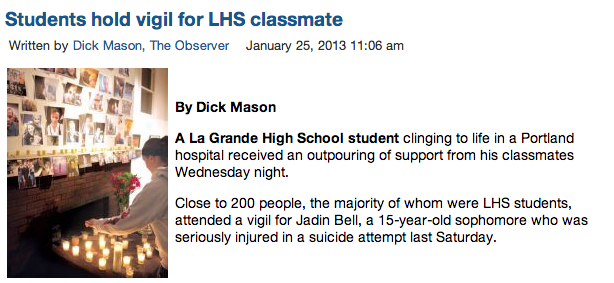
ZimbardoIt’s a conversation we would all do well to take up today – as soon as possible. Lest you think the barrage of anti-bullying legislation and temporarily-increased conversation about how we work to create safe spaces for those students on the margins of our schools has created a culture shift such that we can lay down our worries, there is the story of Portland teen Jadin Bell who died following his suicide attempt weeks ago.

Screen Shot 2013-02-09 at 1.22.12 PM

There is much work to be done, and the consequence of failing to do this work will be the death of other teens who cannot find their way out of the darkness nor recognize those in their lives capable of providing the support they need.

We need more heroes like those Langdon and HCC are working to create, and like New Jersey teen Jacob Rudolph who did more than accept his school’s superlative award for Class Actor when he took the podium, but pronounced he would no longer play the role of “straight Jacob” in hopes of inspiring other LGBT teens across the country who were facing similar struggles. We need heroes like Jacob and like his father, the one holding the camera below and whose text shows his reaction to his son’s speech is one of pride in his son and shame in a culture who would criticize this act of bravery.

We need more heroes.

32/365 Learning Must be Non-Negotiable

There’s a trend I’ve noticed in education. Maybe you’ve noticed it too. Teachers are no longer teaching “students.” They suddenly find themselves teaching “learners.” What’s more, with this shift, many teachers find they aren’t even teachers any more, but have taken on the new title of “educators.”

Many times, it is easier to change what we call something and then point to it as innovation than it is to change what we do. One major issue with calling students “learners” one day and keeping them in the same classrooms with the same people doing the same things they were doing the day before is the ease with which the title change can be conflated with a change in what is actually going on. I could insist that people start calling me a male model tomorrow, but this would do little to attract the attention of agents, magazines, etc., if I didn’t also change how I live my life and what I deem important.

Such is the case with calling all people enrolled in a class “learners.” It’s aspirational, and that’s admirable, but changing what you call a thing means nothing if you don’t also change the way you do that thing. What’s more, changing what you call the thing can often mean a loss in urgency regarding changing how you do the thing.

Learning, on the other hand must be non-negotiable. It’s subtle difference, but a key one.

I don’t care if our students are learners, so long as our students are learning.

The latter is more difficult to put hands on, perhaps this is why we’ve settled for the shift in name and decided to qualify the earning of that name with passing scores on exams of questionable worth regarding how appropriate the name might be.

It seems to me, the better questions come from teachers asking themselves, “Are my students learning?” and following that question with, “How can I tell?”

Building on that, the best schools and teachers are the ones that help students ask, “Am I learning?” and following that question with “What am I learning, and how can I use it?” Exceptional schools move out of the way so that students can inform teachers’ professional practice through the identification of what they’re curious about and what they’d like to create.

These questions prove to be difficult because they bring with them the possibility of negative answers. Both teacher and student is liable to answer, “no” at any stage of the game. Such answers are invaluable and frustratingly so. They represent the necessity of re-evaluating what we’ve been doing, asking what isn’t working, and then building something new with the knowledge we might need to go through this whole process time and again as we move toward learning.

Calling a student a “learner,” represents no such problems. It’s hard to imagine a case in which a person would reject the label no matter the presence or absence of proof of its fit. Walk in to any classroom and ask a student, “Are you learning?” and you’re likely to get myriad responses. Ask that same student, “Are you a learner?” and it’s much more likely you’ll be answered in the affirmative.

Still, the schools we need are not schools where students proudly introduce themselves as learners to those passing through, but they are schools where those passing through have no doubt that the work, play, and creation they see are acts of learning.

31/365 Three Infographics You Should See (plus one more)

Infographics are fun, right? I mean, who doesn’t like their data with a side of pictures?

The three here (plus one more) have been open tabs in my browser for weeks now. While I question some of their findings and methods, it’s in those questions that I see the opportunity to a deeper conversation about the work we’re doing, whose doing it, and why.

1. The (Australian) Achievement Gap

via Nancy Rubin, developed by Open Colleges

While focusing on the Australian perspective, this graphic strikes me as interesting to deploy into a classroom where (U.S.) students are investigating other cultures and attempting to make sense of charts/graphs.

2. Teachers Embrace Digital Resources to Propel Learning

via Josie, developed by PBS Learning Media

While the use of pie charts is questionable, dropping this graphic at the top of a faculty meeting or using it to start the development of a school or district tech plan could generate some great conversation. Of particular interest: How is what we see here reflected in our own learning space? What do we see that we want to know more about?

3. The Social Media Cheat Sheet

via Alex Shevrin, developed by Flowtown

Alex shared this in our ongoing conversation in our Antioch University New EnglandP2PU course on social media in education (come join), and I love it. I’ll be using it whenever I get the chance to talk to teachers about affordances and constraints of social tools in the classroom. If I were teaching right now, it’d also be a starter for a class conversation about how we could build things in class that were useful and connected to the outside world. Love it.

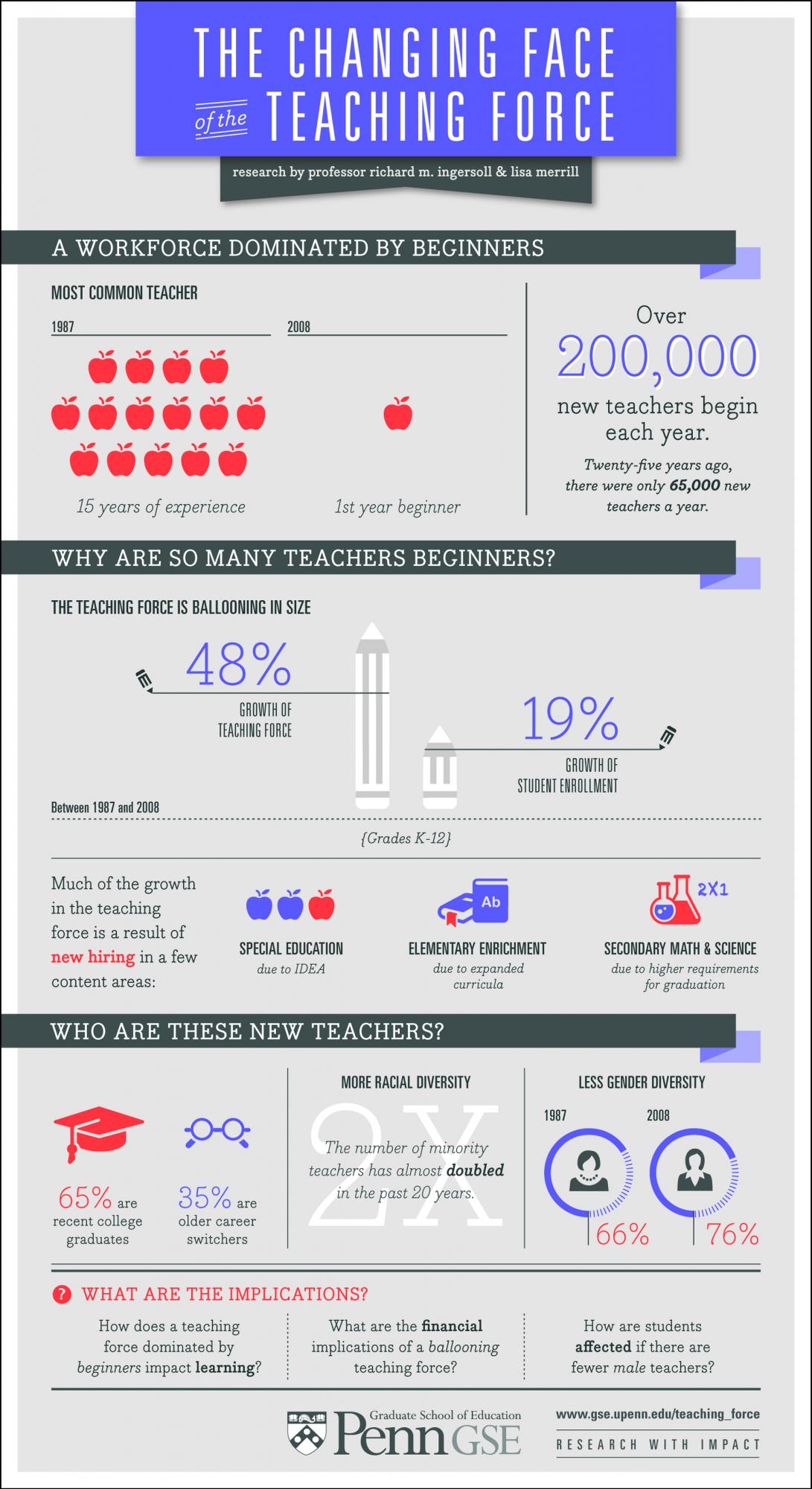
4. The Changing Face of the Teaching Force (I promised one more)

via Penn GSE, developed by Richard Ingersoll

One of the conversations I keep coming back to as I work with student teachers is, “What will your impact be in the classroom?” If you’re guessing I’ll be pulling in this graphic for one of our future seminars, then you are correct. Ingersoll’s work is presented in a provocative and consumable way, and I’ve had many conversations about what the shifts he highlights might mean for the shifting picture of the students in those classrooms as well. If I were working in a district HR office, this would be how I started thinking about hiring practices or examining what we already have in place.

30/365 Vision Must Live in Practice

Many schools have mission and vision statements. Some of those schools also have a listing of core values. Within this subset, we might even find a collection of schools who have drafted essential questions.

What is painfully, distressingly and alarmingly true about many of these schools is the proportion of them that draft these well-meaning documents, file them, and never ever return to them again – until it’s time to craft some sort of improvement plan. This is only slightly better than those who print these driving statements on banners for all who visit to take note as the actions they observe are in stark contrast with the values literally hanging over their heads.

Vision must live in practice.

The same is true of mission, values, and driving questions.

At SLA, we worked to constantly ask how the school’s core values of inquiry, research, collaboration, presentation, and reflection can be seen in the learning experiences designed for our students. While not every piece of work the students complete speaks to each of the core values, asking the question over and over again helps to ensure we are constantly practicing those things we proport to value most.

The vision of a school can only live in practice if it is shared by all within the community. We have seen many schools where teachers arrive for their first professional development day of the new school year, sip coffee from industrial-sized mugs and listen as the school’s principal stands before them and explains the vision for the new school year. Often, too often, this is a vision devoid of any remanants of the vision of the previous school year.

While it is understandable for a principal to endevour to energize his or her faculty at the start of the new year, shifting course dramatically and often will only lead teachers to pay lip service to the “new” vision while resorting to those goals and values they find most comfortable when they return to their classrooms.

Any principal would be better off to find a vision in which he or she can truly root the desired practice of a school and then seek ways to embody that vision in every action of every individual on the campus. Then, when that has happened, the next step is not to find a new way of saying what you believe, but to deepen the expressions of those beliefs and values key to your institution’s identity.

It is easy to attempt to be what we repeatedly say, but it is always better to do than to merely say.

Coming to terms with what a school believes and is about as a learning organization is a strong first step. As with so many journeys, it is the steps that follow that determine what you will become.

When vision is put to practice, when who we want to be is a constant reflection in practice, then we are able to move closer to the better versions of ourselves and our institutions.

29/365 Initial Thoughts on Caring in Online Spaces

I’ve written extensively here about the Ethic of Care, and it’s something I’ll speak about to anyone who’ll listen.

Lately, I’ve had the chance to talk and listen to people about a quesiton that’s been jumping around my brain. Namely, how do we enact an ethic of care in online spaces?

Today, I had a conversation with a former student. She’s in college now, studying to be a teacher, and wanted some advice on what to disclose to her eventual students and what to keep private.

Her concern was driven by her experiences in school and the realization she would have benefitted greatly from an adult in her life who’d been open about being where she’d been.

She wanted to know how I’d approached similar situations in my practice.

She’s in Philadelphia.

I’m in Boulder.

What’s more, I was in class at the time.

The conversation popped up through the google voice plugin I’ve installed in Chrome.

She was texting me. I was typing back on my browser.

As I built my understanding of qualitative theory and research practices, I was also attempting to guide a future teacher in her thinking about her practice.

Somewhere in there, care resides.

She had the number because I’d created it when I was in the classroom so that I might ask kids to submit questions or responses using their phones. If they had no phones, they were able to send the text via a chat client.

She kept the number.

I’m glad she did. (I hope others did too.)

If I can continue to care for my students, let them know my care for their learning didn’t end at Day 180, I’ll leverage whatever tools possible to do that. I understand the counter-arguments to this approach. It can be abused and used for nepharious purposes. I understand this to be true. I have a hard time seeing how those who would abuse these tools are going to be convinced to stop using them because those who would use them to help students refuse to consider the tools.

If anything, this is an argument for their widespread adoption of these practices by thoughtful and caring professionals who are driven by high standards of compassion and see their work as nurturing their students in safe spaces. Without such a precence, digital environments will be devoid of care. Minus that care, danger fills in the empty spaces.

I’m still tinkering with a more unified theory of care in online spaces. The conversation today helped me to see it in action, and that observation helped me to understand the power and necessity of such connections and availability.

It also left me with questions. Would this student have recognized my care for her if we’d not interacted in face-to-face environments? Did she benefit from our conversation in the same way she would have if we’d been in the same physical space? Was the caring relation reciprocal in the same way if can be in face-to-face interactions?

I don’t have answers to the questions, but I’m glad they’re getting more specific as I look more closely at trying to understand the issue.

28/365 ‘All Wretch and no Vomit’

My days, as of late, have been spent deeper in the study of “why X isn’t happening” than I’m used to or comfortable with. I knew a piece of this would likely happen when I moved from teaching and the daily amazement of the classroom to the life of a graduate student last year. I knew the conversation would likely become more insular when I started a research doctoral program this year.

Still, I’ve never felt comfortable not making things, not doing things, not moving. My elementary school report cards (the last ones to include narrative feedback) noted this discomfort: Zac is a joy to have in class, if he could just stay in his seat and curb the talking.

While those are tasks I’m able to master when fully focused nowadays and the talking is usually questioning, they’re not my default. I like to do things.

Dense readings and statistics assignments, though, have a way of asking you to sit down, shut up, and then do that some more.

Today, Anthony (a friend I’ve not spoken to since I finished undergrad) posted the video below to the book of faces, and I watched it. This is a rarity. Most Facebook videos elicit a scroll-by from me. For whatever reason, I watched it. I’m glad I did, and I wish I could make it so that every next faculty meeting planned at schools across the country start with this video and then proceed to a deep conversation of, “How can we help our kids answer this question and realize their hopes?”

I’m not familiar with Alan Watts (yet) and infinite voices are likely able to list the myriad reasons why what he describes isn’t possible for so many of the children in our care. I find myself uninterested in those reasons or at least not paying them the insurmountable heed  most conversations in education tend to lend them.

What other reason to work in education than to be aspirational? I can think of no word or sentiment that so finely describes what drew me to the classroom each day or what I hoped for my students. And, while I aspired for their success, education and teaching were about my own aspirations, that I might be the better version of myself that I hadn’t quite become the day before for whatever reason.

Let us do more with aspire than emptily attach it to the name of some new school. Let us enact it. Let us use it to drive our decisions, our questions, and our care.

Thanks, Anthony.

27/365 Let’s Have a Better Conversation

My friend Sam Chaltain is telling “A Different Story About Public Education,” and I get to help him. Not only that, a great many voices are part of this conversation.

For 10 weeks, Sam and other edu-thinkers will be considering one episode per week of a series called A Year at Mission Hill that documents a year in the life of a successful public school.

In true trans-media spirit, the series promises to be a convening of those who are asking questions and doing the great work of improving public schools. More than that, it’s a portal that invites involvement in both the better conversation and the great work.

EPISODE ONE:

For my part, Sam’s given me space on his EdWeek blog to consider contemporary research relating to each chapter and try to filter it through the lens of a classroom teacher who might be interested in using the the work of ivory towers to improve their practice. My first attempt is here.

If nothing else, follow A Year at Mission Hill because it promises to ask, “What’s going write in public education?” rather than operating from the deficit perspective that’s all too familiar for anyone who’s listening to the rhetoric surrounding our schools. Let’s celebrate the greatness that’s possible, and ask how to help it spread.