At the end of May, I’ll be doing something different with my life than I was doing in October and different still from what I was doing 365 days before that. This promises to be a year of change to rival the changes of years past.
As I was working on my resolutions for the year, I kept this in mind. I want to document the year with the same spirit as last year, and I know another daily writing project will run the risk of draining me and distracting me from experiencing what’s going on as the changes take place.
As such, I’ve arrived at the following resolutions:
1. Run every day for at least 10 minutes. This one was clearing inspired by last year’s project. I understood the why better through explaining it to someone else. I came to know myself as a writer last year by putting myself in writing each day. In the same way, when I get to know people, I think of myself as a writer and a runner. So, I’ll be running. It’s a new approach. I’ll be running for 10 minutes some days, though my mind will want to go farther. I like that. I like actively working to shift my paradigm and experience as a runner. I’m also knowledgeable enough as a runner, at this point, to know to listen to my body and be mindful of the injuries possible in such an undertaking. If this year is to include the geographic changes I anticipate it to, experiencing where I am and who I am in those places through running will be interesting.
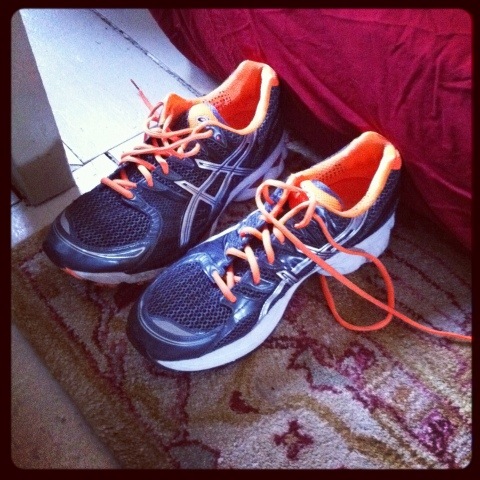
2. Make one photo each week that represents that week of the year. I thought briefly about a photo-a-day project, but my sister, Kirstie, helped me make up my mind. Kirstie is, as I have said, a brilliant photographer with a keen eye. She completed a 365 project last year to tremendous results. When I asked her if she would be continuing it this year, she said no. The goal of a photo each day meant she wasn’t creating shots of the quality she wanted. I can appreciate that. This year, she’s surveyed 52 friends and family members for inspirations quotations and ideas. Each week, she’ll be creating a photo each week around one of those guiding ideas. My project will be less global and much more self-centered, but I hope it to be a catalog of life this year that pushes me to think more visually. The photo above was my first week’s attempt.
3. Go vegan. I’m still a little sketchy of the details on this one. I wrote last year of my month-long go at eating vegan and the cultural and personal quandaries it inspired. Since then, I’ve continued to consider my role as a citizen, the effects of what I eat on who and what I am, and the footprint of all of this. I’m starting to think of this as a biological retirement plan. More on this later.
4. Journal each day (even if it’s only a line). My mom journals every day. Leading up to the new year, she spent her mornings on the couch reading through her life in years past and remembering the connective tissue of who she is now. For a long time, I journaled alongside my students in class. It’s different than blogging, and I want to remember why.
5. Read 52 books. That’s it. Similar to running, I count myself as a reader. As much as I could easily remain among the choir who chant solemnly they “don’t have time” to read, I know I can make time for this. To be sure, grad school will continue to help push me toward this goal. The other piece is one of genuine living. In the classroom, I told students over and over of the connection between reading, writing, and thinking. I insisted they would be better writers for reading and vice versa. If I am to stand by that and improve as a writer, I must read. Fifty-two is an arbitrary goal furnished by the calendar. Still, it’s as good a number as any.
I didn’t intend 5 resolutions this year. It just shook out that way. As much as I’m excited to work at each of them, I’m excited to find how my internal understanding and logic of the rules surrounding each resolutions shifts during the year.
I’m most curious to see how they shape me.
Day: January 9, 2012
What I Read: ‘You Are What You Speak’ by Robert Lane Greene
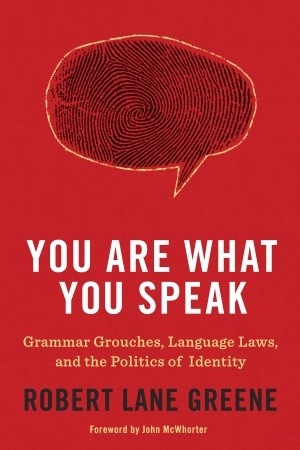
One of the reviews of this book faults Greene for writing about linguistics without being a linguist. I don’t find the same fault in the pages here. Certainly, this has the density one would expect from an Economist writer, but don’t let that fool you.
As an English major and English teacher who has been thinking about these things for some time, the initial introduction to prescriptivism and descriptivism did much to act as a refresher for the topics and lay the foundation of the different global perspectives of the book.
From a historical understanding of the resurrection of Hebrew to the formation of modern Turkish (an subsequent distance from pre-1930 Turkish texts), I’m walking away from this book with much richer and deeper understanding of language and it’s formation around the world.
Perhaps most helpful for me was Greene’s clear love of language. If there were any impediment created by his lack of training as a linguist, his love of language makes up for it handily.
Reading about language from the perspective of one who is so clearly curious and in love with language shapes the book as a tool for infectious love of language.
If you’re curious about language, read this. If you’re passionate about language, read this. If you are hungry for a appropriately-dense text acting as a primer to understanding linguistics, read this. It’s not a book for everyone, but it’s definitely a book for those who love and are fascinated by language.
cross-posted at http://goodreads.com/mrchase