I won’t be telling them what to think

The Gist:

  • My G11 students are reading The Great Gatsby.
  • After the choice afforded them in the last quarter, I can’t be every other English teacher.
  • We’re challenging the Academy and having numerous books vie for the title of Great American Novel.

The Whole Story:

Monday, I tweeted out the link to a simple questionnaire. It contains two statements: 1) What is the Great American Novel? 2) If you’d like to make your case, do it below.

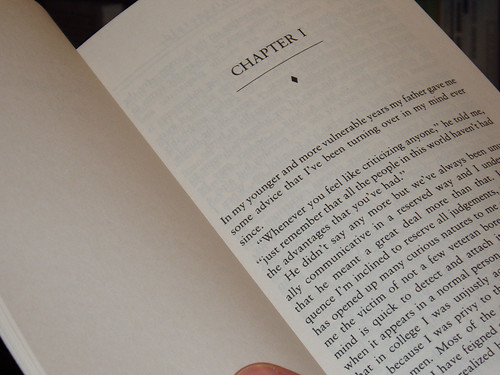
My G11 students also received their copies of our latest class novel Monday. Maybe you’ve heard of a little book called The Great Gatsby? Apparently, it’s quite popular. In fact, many argue it qualifies as the GAN.

Narrowing down the results of the questionnaire, my classes will be pitting 8 contenders against one another. The final contender will face off against Gatsby.

I’ve written about this before. The original idea was to put Gatsby on trial for libel and slander against other novels. After consulting with many people whose thoughtfulness and opinions I greatly value, I was left with a sort of literary March Madness.

I won’t be walking my students through Gatsby. I won’t be indoctrinating them to the symbolism of that light at the end of that dock. I won’t be talking about the American dream or gender roles and the power of adhering to them.

Instead, I’ve given my students some simple instructions:

Read this book with the idea that you will either have to argue against its status as the GAN

or defend its standing as the GAN.

If the American dream and gender roles and symbolism are really key and keen in the text, they should pick up on them. If something else is there, they’ll pick up on that. Is the symbolism important because my teachers told me it was there or because it’s important? I want to start clean.

We’ve talked about some strategies for tracking their thinking. They can use the tried and true sticky notes. They can make a bookmark for each chapter where they track positives on one side and negatives on the other. They can take notes in a notebook. Turns out I don’t care.

They’ve until April 5 to finish.

During classes, they’ll frequently have time to read, about 20 minutes. Tomorrow, I’ll help them decide how to schedule their reading. They’ve 180 pages of 9 chapters and either 12 or 7 days depending on if they want to read over Spring Break. Their pace and rate are up to them.

During the remaining 2/3 of class, we’ll be debating and deciding the qualifiers of the GAN as well as practicing discreet reading and writing skills using other texts.

April 5, they’ll compile their notes, hand in their copies of Gatsby and find out which text they’ll be reading over the next two weeks. This will, be the text on whose behalf they’ll be arguing.

Rather than discussing qualifiers of the GAN, we’ll be using non-reading class time to examine literary lenses they can use to make their cases – Feminist, Marxist, Reader-Response, Postcolonial, Deconstructionist, New Criticism. Throw in some more discreet skills, and you’ve got a hopping time.

The results coming in on the questionnaire are backing my decision to head this direction with things. Largely, the texts suggested line up as canonical standards. It seems dead white guys were really in touch with how to write in a way that resonated with the American spirit.

My goal for this is not to have my students look at any of these texts as the GAN, but to look at these texts and ask why they hold the status they hold and then ask whether or not they deserve that status.

I’m curious to see what they think.

You’re probably asking, “Wow, Zac, that’s great. But, what can I do to help?”

Great question, you.

If you haven’t already, take about 2 minutes to complete the questionnaire and nominate your contender for GAN.

Starting Friday, we’ll be seeding the top 8, check back then to help fill out our brackets.

Oh, one other thing, talk about your nominee with someone. The conversations I’ve had in the last two days have definitely enriched my appreciation for literature. If nothing else, twitter’s seemed less monocultural for a day or two.

This is better than writing a paper

The Gist:

  • Thinking about texts is complicated.
  • The ideas of success and greatness are fluid and subjective.
  • Rather than a paper, I’m having my students document their thinking.

The Whole Story:

This piece of work won’t end in a paper. If you’re a traditionalist English teacher-type, you should abandon hope.

In Storytelling as of late, we’ve been working with short stories.

Three questions have held our focus:

  1. What makes a short story?
  2. What makes a great short story?
  3. What makes a successful short story?

With the consideration of each question, the students have been keeping lists qualifiers they identify as we work through some classic and contemporary examples. The other day, they received this assignment:

Today, you’re working to create a flow chart I can apply to any text and correctly end at one of the five following conclusions:

  • Not a short story.
  • Short story, neither great nor successful.
  • Short story, great, not successful.
  • Short story, not great, successful.
  • Short story, great and successful.

To create your flow chart, use one of these five tools:

Once you’ve completed your flow chart, post the link to the final published chart here.

Admittedly, “correctly” in the opening sentence was subjective, but it took the kids to some interesting places.

Hannah created this.

Narayan and Jarmel created this.

Jesse did this.

Patrick did this.

And, Levon did this.

When everyone’s chart was submitted today, the students beta tested:

Pick a flow chart here.

Plug in 5 different texts:

  • Not a short story.
  • Short story, neither great nor successful.
  • Short story, great, not successful.
  • Short story, not great, successful.
  • Short story, great and successful.

Keep track of where it comes out. Take notes of where you got lost or where you needed more direction. Pass your notes on to the flow cartographer as a reply in the forum.

Repeat for two more charts.

Not only did it lead to some interesting informal discussions of what constituted “great” or “successful,” it pushed students to revise and iterate their process for arriving at these conclusions.

I won’t be assigning a paper at the end of this. I don’t need to. Writing a paper no one will care about is not the skill I want them working toward. They’ve shown me their thinking in a way that is more accessible than they’ve be able to in a collection of paragraphs analyzing one or two chosen texts.

This, I can interact with.

Waiting to understand

The Gist:

  • A little over a week ago, I started trying to contact @EdPressSec on twitter to ask some questions about the elimination of direct federal funding for the National Writing Project.
  • When I didn’t get any answers, I moved from twitter to phone.
  • Though I’ve had a few promises that I’d be gotten back to (often by the end of the day), I’m still waiting.

The Whole Story:

This all stems from a few simple questions:

I’m attempting to understand, to gather more information from a variety of sources in order to be better informed.
Friday, I received a three calls from the DOE’s press office. Each person told me they would pass my request on to the appropriate person. Thus far, I’ve not heard back.
I understand the frenetic and demanding nature of the job of working within the press office. It’s why I wasn’t surprised when my initial calls took a few days to return.
But, this is a conversation worth having and one that deserves transparency.
I fully support the use of tools like twitter to offer a more fluid connection between citizens and their government. At this point, though, I’m getting the feeling the tools are being used to push out prepared statements, but not really communicate.
I’m feeling rather frustrated.

Finally, no one cares what I think

The Gist:

  • Presentations of classwork usually end up with me being talked at and 30 disinterested teenagers trying to hang on.
  • Giving the students “evaluations” to fill out generally smells of busywork.
  • By putting approval power in the hands of my students, I’ve seen a complete turnaround in how work is being presented in class.

The Whole Story:

When we talk about authentic learning in the classroom, we usually mean almost-authentic learning in the classroom. When we talk about giving our students authentic audiences for their work, we usually mean finding places for their work to live should the right audience happen by. I’ve done this before and likely will do this again. Sometimes, it’s all I can manage.

With the CtW project this year, I’m trying something new. Though I’m calling this Phase II, it’s really Phase III or IV. First, students individually researched problems/issues in which they were interested. Then, I broke them into affinity groups based on similarities of their respective issues. Then, I told them to compare what they understood as the causes of their problems and find one element common to all of their issues where they could apply singular pressure as a cooperative unit to affect change across issues.

We’re in it now.

Friday, the groups started pitching their ideas to their classmates. That sentence makes it sound like traditional group presentations – the kind I worked for about 30 seconds to stay focused on as a student.

I hated those moments.

Instead, each group’s progression to their next phase depends on garnering unanimous approval from their classmates. When I ask if they’ve gotten to a point at which we as a community are ready to set them loose as representatives of our class and our school, every hand must go up.

Thus far, two groups have presented. Neither has made it through the gauntlet. The work they’ve presented thus far has been some of the highest quality, most inclusive of any group presentations I’ve seen. They know what they’re talking about, they care about what they’re proposing and they know their audience matters. Still, I’ve agreed with both votes. It’s not quite where it could be. I agree with what they’re saying.

While they’re presenting, no one talks to me. Even better, the audience is talking back.

During Q&A after the presentations, I have to wait to be called upon. That never happens.

The groups know my vote doesn’t matter. In fact, I don’t get a vote.

The audience knows they have a say in what they’re seeing and they’re reading the presentations as texts to be questioned and challenged.

When a group presents a 2-minute PSA about the dangers and effects of inhumane acts, the class doesn’t give them a bye because their video was good but their plan for implementation of their ideas was shoddy. They know the bells and whistles and they don’t care.

After each vote, the class heads to a Google Form where they rate the groups’ effectiveness at meeting expectations for the presentations across SLA’s benchmark rubric categories.

At the end, the students must answer the question, “What suggestions do you have for improving the pitch? What questions are still lingering in your mind?”

Most of the time we talk about authentic learning and giving our kids an audience, we’re ignoring the authenticity and audience within our own classrooms. We’re so interested in giving them new places to be listened to, we don’t ask them to listen to each other – we don’t give them reasons to. That’s important.

After typing up my comments, I send them via e-mail to each group along with the link to the sheet of a Google Spreadsheet with all of their peers’ feedback.

They’ll be using the feedback to improve their presentations and gear up for round two.

Admittedly, I’m watching the unanimity idea closely. I’m fairly certain the class will recognize when a presentation has proven it’s muster, but I’m paying attention just in case.

To my mind, this process stands somewhere between the peer editing I’ve seen in Writers’ Workshops and peer review in the submission of scholarly work.

Most importantly, I’m far from the most important person in the room when the kids are talking and holding one another accountable.

One of the moments we talk about

The Gist:

  • The federal budget has eliminated direct funding for the National Writing Project.
  • Without the funding, it’s unlikely this national model of a successful networked collective of professional development can survive.
  • This is one of those moments when the network we talk about so frequently can make the difference we’re always claiming it can make.

The Whole Story:

If you haven’t written your congresspeople to support the National Writing Project, you need to.

My last post focused on the letter I’ve used to contact my congressmen. Thanks to Karl and Ben for reposting. Also, if you haven’t read Bud’s letter, you should.

I need to make clear, that, aside from being able to speak at NWP’s Digital is… conference in the fall, I’m not directly associated with the Project.

I simply realize it to be a good idea. A really good idea with a proven record, a tendency toward self-evaluation and networking hundreds of thousands of teachers together with a simple purpose.

It’s one of those few black and white moments in policy. The NWP works. It works better than any other national education program that comes to mind.

So, here’s the thing, this is one of those moments we talk about when we talk about the power of network, when we stand and tell rooms full of teachers about how being connected means our students have greater voice and greater power as citizens. It strikes me this is one of those moments we’re talking about.

Only, it’s not our students, it’s us. Yes, it’s about our students, as they are the ones the NWP is impacting. But the voices that should be raised first and loudest in this moment are the voices of teachers.

My voice right now is one of questions. Specifically, I’m with Bud in asking to see the reasoning behind cutting the funding and how that reasoning stands up to the substantial evidence that the NWP is doing exactly what it is meant to do and what no singular state-based program could accomplish. I hope to receive response soon.

Honestly, though, the likelihood of response is increased with each additional voice.

Speak up.

Ask your representative to sign Rep. George Miller’s Dear Colleague letter. Call your local NWP affiliate to see what you can do to help. Most importantly, make this a conversation where you live, in your virtual and real spaces.

Again, this isn’t national standards or RTTT or any of the myriad issues with equally numerous and complex perspectives.

NWP works.

Tell people.

Make sure one of them is your Representative.

Open letter on behalf of the NWP

The Gist:

  • The current draft of the federal budget cuts direct funding for the National Writing Project.
  • The NWP has been one of the few extremely successful examples of a nationally-networked effort to improve K-12 writing for 36 years.
  • We must communicate with Congress to change the budget.

The Whole Story:

Dear Rep. Fattah, Sen. Casey and Sen. Specter:

I write to you on behalf of the National Writing Project. More precisely, I write to you on behalf of the hundreds of thousands of students and teachers the program has transformed over its 36 years.

Under the budget proposed by President Obama, national funding for the NWP would be cut. In a Feb. 1 press release from the U.S. Department of Education, the NWP was lumped in with 5 other projects losing funding because the DOE claims they “duplicate local or state programs or have not had a significant measurable impact.”

As the NWP is unique as a networked writing instruction program with 200+ local sites serving all 50 states, the District of Columbia, Puerto Rico, and the U.S. Virgin Islands, I am left to believe Sec. Duncan is claiming the NWP falls under the category of not having a “significant measurable impact.”

This too is untrue.

A 1987 longitudinal study on the effects of the NWP by Kathy Krendl and Julie Dodd found participating third through twelfth graders showed an increase “in interest in learning about writing, in their level of confidence, and in their association of self-esteen with good writing.

Not only that, the study also found a decrease “in students’ feelings of discomfort about completing writing assignments and in their feelings that they do not write well and that writing is difficult.”

In a 2007 study of the NWP’s Local Site Research Initiative, across nine localities students showed significant or non-significant favorable results in all seven categories.

This should not have been surprising considering the DOE’s own data listed the NWP as exceeding its performance targets in 2001. Indeed participants’ ratings across all categories ranged from 95-88 percent reporting positive impact at their follow-up assessment of the program. This went well above the program’s target of 75 percent in each category.

Were this simply an impassioned plea, I would have hesitated to write. The data speaks for itself, the National Writing Project has offered a significant return on investment in its 36 year history. Federal funding for the NWP must be maintained if we are to continue striving to meet the Project’s goal of “a future where every person is an accomplished writer, engaged learner, and active participant in a digital, interconnected world.”

I thank your for your time and attention to this matter. Please, let me know if I can be of any assistance.

Sincerely,

Zachary Chase

English Teacher

Science Leadership Academy

Philadelphia, PA

(Note: See also Bud Hunt’s post on this topic.)

Time I was Wrong #3,596,897

The Gist:

  • The CtW Project is something different this year.
  • My students are grappling with the issues and their possible solutions in more authentic ways.
  • I’m teaching ways of reading that won’t be tested.

The Whole Story:

The project description around Phase 2 originally stood as:

Phase 2: Research work being done to solve problem. Create campaign to get donations for that work.

Draft an action plan around a realistic solution to the problem you’ve selected.

Meet with an identified change agent and present your pitch and action plan.

We’ve moved away from that.

Last year’s iteration of the project wrapped itself around an Ignite-style presentation uploaded to slideshare and then posted to the students’ drupal blogs. There they have languished for almost a year. I’ve called them up for conference presentations, but they haven’t been affecting much change other than that of classroom practice, perhaps. It’s striking me as ironic that I used one group’s product from last year as an example during my “Doing Real Stuff in the Classroom” session at CoLearning. If it had been “Doing Almost Real Stuff in the Classroom,” well, then that would have been something.

From the original description of Phase 2, we’ve scrapped the donation campaign, the action plan and the pitch to a change agent. Everything.

As I wrote earlier, I’ve move kids who have been researching similarly themed projects into Solution Groups. Armed only with a fact sheet built off of their 6 weeks of research and a Solution Organizer that helped them to put their thoughts in order, the groups met to share their work and discuss their individual goals for changing the issue each had been researching.

Once the groups had decided whether or not my initial groupings would work / made sense, they set to work making connections across their problems to identify a singular action that could catalyze change in each issue.

It was fascinating to watch.

After two classes, I sat with each group and had them pitch their proposals. What they came up with was better than any donation campaign my brain had envisioned.

One class has a group organizing around the issue of abuse in its many forms. They’re planning to create a resource for SLA students dealing with abuse, contacting counselors to help them and organizing a fundraising walk to help a local non-profit working with people living in abuse.

Again, more than a video dying on drupal.

As I moved from group to group, I realized no one had talked to these guys about leveraging and social media. We talked about the fact that the room probably had around 5,000 Facebook connections they could push. Then I showed them Southwest’s twitter page and we discussed why 1 million+ people would even think about following an airline.

We watched this video I’d seen the night before thanks to Ewan:

And that led to a discussion of non-verbal communication and how a video with only 6 significant words could lead to change.

Anthony commented, “That video changed my life.”

We’ll see.

From there, we visited Chris Craft’s kids’ TeachJeffSpanish.com and I walked my students through the idea that a class of sixth graders had built a site with the potential to create real sticky change.

Finally, we ended w/ a google search for “Joe’s Non-Netbook” and then “Joe’s Non-Notebook” as some re-posters have called it. I told the kids how I shot and posted the video on a whim almost a year ago.

The real fun was looking at the stickiness of the video. My original posting has 2451 views. This posting has 9673. This one has 730. There might be more, but I didn’t care.

We stopped looking at re-postings and started checking out where people had written about the video.

They started to get the idea that this video recorded as a gag had made an impact.

“You’re the first generation to be advertised to since birth,” I told them, “You’re going to need to be the savviest thinkers about this stuff so far.”

Having made it through my filter with their first pitches, the groups will begin drafting sales pitches Monday that will have to meet with unanimous class approval to move forward. It’s our own little ad hoc shareholders meeting.

So, yeah. That’s happening.

Meanwhile, the PSSA looms on the horizon and I can’t help thinking I’m going to have to move their brains into a mold where they see questions as having one answer and answers as being un-refineable. You know, like in the real world.

The ideas they’re working with now are big ones. The solutions they’re striving toward are impassioned and thoughtful. Come April, they’ll have four weeks of testing that doesn’t fit any of those descriptors.

Oh well.

via Hoffman

Tom Hoffman posts this from Caroline Grannan:

Well, I have a proposal. Those 93 teachers, support staff and administrators should get together, pull the necessary strings (which are in their reach right now while the story is hot), and request a meeting with the president – all 93 of them. If Obama could have a beer with Henry Louis Gates and that cop whose name I’ve now forgotten, surely he’s willing to spend a little time hearing the viewpoint of 93 people whom he has essentially attacked sight unseen. While it would be hospitable for him to invite them to the White House, it would be a lot classier for him to have a soothing spot of tea catered in at Central Falls High School. (And he desperately needs to show a little class right now; his supply is perilously low.) I’m sure the cafeteria has enough room to seat the Central Falls 93, Obama and his entourage.

Technically, in this comparison, isn’t President Obama the cop? Maybe the UN should have them over.

Cardboard Boxes for Everyone!

The Gist:

  • Thought and Idea are different things.
  • We encourage both in the classroom.
  • I’m not sure which I privilege more.
  • I’m not sure which I should.

The Whole Story:

Disclaimer: My line of thinking here is protean. Ideally, I’d play with it as a comment somewhere first. As I haven’t run into such a post yet, I’m diving in.

I spent much more time than I thought I would in the last post trying to parse out what I meant or needed from differentiating thought and idea. I think I got there. The final point was where I was headed. And, hey, who doesn’t like finishing writing and finding they’ve called their colleagues hypocrites?

Let me first turn to my own hypocrisy before I start talking practice. I wasn’t playing for a while there. It’s a shame really, because Mrs. Cavitt made a point in kindergarten of stating I play well with others . Right now, my play is commenting. I figure if the minds I admire are bringing their toys to the table, I might as well play. Down the road, we’ll see what ideas spring from it. For now, I’m making time to play.

As for my classroom:

I’d be hard pressed to find a day when I don’t directly ask my students to think. I’d be hard pressed to find a day when I don’t directly ask my students to come up with ideas. I do these things as a matter of habit. I’d imagine any teacher does.

But, do I mean it?

When I ask a student to think, I think I do mean it. I want them looking for patterns, connections, variables, ideas. I want them thinking. The world needs them thinking. When they watch television, I want them thinking. When they’re at the movies, walking down the street, riding the trolley – I want them thinking. I want them to think as often as possible. When I ask it, I mean it.

My aims with ideas are squishier. I ask for ideas. “What ideas do you have?” I’ll ask. Some days, ideas are in season and falling from the sky. Some days, not.

When the ideas don’t come, what do I do? Usually, I talk. Sometimes, it’s a statement. Sometimes, it’s a question. Rarely, is it anything that looks like asking them to play with their thoughts until ideas happen.

What message is this sending? Honestly.

If I’m asking for ideas and they don’t come, shouldn’t I be asking them to play?

“Teaching them to think,” pops up more likely than I’d like in my reading online. Aside from being asininely presumptuous, it sounds dangerous. They know how to think. Sure, maybe some of my students don’t think as deeply or complexly as I’d hope for them, but they’re thinking. I don’t need to teach them to think, I need to give them space to think. I need them to have space to play with thoughts, put them together and make ideas.

I don’t know that I let that happen as much as I’d like. The feeling that they could do that much more if I made sure they had this tool or experience with this line of thinking leads me down the path of profering too much.

I end up the parent whose child has 1 million toys but is sitting playing with the cardboard box in which the last toy arrived.

The project my G11 students are working on now has taken a turn toward play. I’m working on making the necessary adjustments for my G12 kids.

I should be privileging ideas as much as I’m privileging thinking.

The difference between idea and thought (Post #1)


vs.

The Gist:

  • Thought and Idea are different things.
  • We encourage both in the classroom.
  • I’m not sure which I privilege more.
  • I’m not sure which I should.

(Note: I started thinking more than I planned. The last three points will have to be in my next post.)

The Whole Story:

Disclaimer: My line of thinking here is protean. Ideally, I’d play with it as a comment somewhere first. As I haven’t run into such a post yet, I’m diving in.

Claim the First: Thought and Idea are different concepts

It’s highly likely that everyone is on board with this already, but I hadn’t been until recently. Asking me to think about something and asking me to come up with an idea are different requests. To me, thinking can include, but isn’t limited to, walking and making connections between the intellectual paths of others. Having an idea, though, is making something new, sometimes utilizing those intellectual paths, sometimes operating apart from them. Social bookmarking is an idea. Figuring out how to create it, utilize it, improve it are all thoughts.

Claim the Second: Thought usually precedes idea

Continuing the social bookmarking example, whatever the first iteration of social bookmarking, its creator likely went through a thought process driven by a problem. The thought process probably noted the insufficiencies inherent in the present situation as well as the desired features beyond those insufficiencies. With thinking, the process can end there. It can end at any step of the game: “Oh, there’s a problem.” “Oh, here’s why this problem exists.” “Oh, here’s what I’d like out of a solution to that problem.” “Oh, here’s what it would take to make that solution real.” “Oh, here’s that solution.” That last part is the idea, arrived at through thought.

Claim the Third: Thought mustn’t always precede idea

More than once, I’ve heard people complain Wave doesn’t solve a problem. They don’t know why they need it because it doesn’t fill an obvious need. It’s an idea that precedes thought. Now, I’m sure Wave’s developers see the need, I’m sure they thought it out. The difference between social networking and Wave exists in the paths of thinking. Many people had identified the problem, the causes and what they’d like to see in a solution leading up to the advent of social bookmarking. Thus, when the idea arrived, it was embraced more readily than has been the case with Wave. Wave was an idea whose time hadn’t yet come.

Claim the Fourth: Ideas from minority thoughts face a greater chance of rejection

The clamor for Wave invitations was as frenetic as the clamor for gmail invitations or the race to blogging, or the race to myspace (remember that?), or the race to space. We’d agreed we wanted to get there because it was a new idea with the force of those we knew behind it. Then, we got to Wave. Then we were there and looking around. Then we started complaining. We didn’t know why we were there. By and large, we still don’t. We’ve started leaving.

Claim the Fifth: The rejection of minority thoughts evidences hypocrisy

A common cry of keynotes and conference sessions and blog posts and podcasts is that we should not only allow, but encourage our students to play. Sometimes we mean this in a social way. Sometimes we mean this in an intellectual way. Either way, the implication is that we are asking our students to play for the inherent value of discovery within play. They will uncover new ideas. Play is thought without repercussions or expectations. When my younger brother dumps out his LEGOs and begins building, that’s play. When he dumps out his LEGOs and begins building based off of the diagram included with his latest set, that is not play. Minority thoughts give us ideas without diagrams and ask us to play. Though we encourage this in our students and claim to be dedicated to it in our own practices, if we can’t see the endgame or the relevance we frequently decide not to play.

This post serves as further evidence. In writing it, I’m asking if you want to play with ideas. In reading it, you’re looking for your diagram, looking to see if my idea lines up with your thinking.  If you’ve made it this far, you likely want to play. If you haven’t, you’re probably not a player. Playing (or commenting) means you either want to see what we can make or that you see your thinking in these words and want to utilize the idea.