The Wonky Road Ahead

The network here is a bit wonky.

According to Charles, one of our liaisons on the ground here, the Ministry of Education (MOE) would have preferred another venue.

That venue did not complete the required rating that would have established it as a Historically Disadvantaged Institution. Evidently, in order to bid for the contract, a business should qualify as a HDI.

We’re working with approximately 40 Senior Education Specialist e-Personnel this week. They work with the 6,000+ schools in the Eastern Cape province. The majority are responsible for tech training for around 300 schools.

At evening tea last night, one e-Personnel boasted that she was able to travel to a record 40 schools in one month thanks to her new government-subsidized car.

Eastern Cape has the third highest population in South Africa and is ranked the most impoverished.

And those are just the socio-economic problems.

Based on multiple reports here, the provincial and national management see ICT as a new problem for them to manage.

They are working under the myth that, “ICT can never ever, ever assist teachers in the classroom.”

Charles would like to erase that myth as his legacy.

I’d like to help.

Still, the network here is a bit wonky.

The e-Personnel haven’t all physically met in the same place for years. They’ve received quarterly training in cohorts.

They don’t know what one another is doing.

As I learned at lunch, “We are not terribly interested in what you are doing in your district as we are responsible for our own.”

Similarly, the e-Personnel have never been in the same virtual space at the same time. The e-Learning unit attempted to get everyone together through a site called SocialGo. It didn’t take.

Seems they didn’t inherently value something because it was new.

Yesterday’s session had the e-Personnel logging in to a moodle course we’ve designed for the week. It holds the readings, it holds the homeworks, it holds the forums for discussion. It means something to their progress.

Everyone had to download their homework files and fill out their moodle profiles before leaving the meeting room at night.

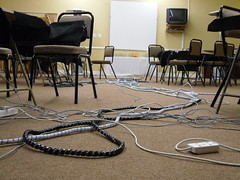
We haven’t any wireless access. They needed to be plugged in.

The network here is a bit wonky.

Today I learned something about different

I went to the SuperSpar today.

It was no cheetah, but it was interesting.

While the rest of the team was tidying the odds and ends of their workshop sessions, I took on the task of lunch and dinner preparation.

SuperSpar, btw, is a brand of grocery store chain here. I didn’t go to Spar or KwikSpar. I went to SuperSpar. South Africa is rife with Spars.

If you’ve never been to a grocery store in a country other than your own, it’s a bit trippy.

It’s clearly a grocery store. You can tell that as you walk in. There are groceries.

Little things, though, are different.

Eggs are left out stacked on pallets on the floor rather than in a refrigerated case.

Milk comes in a foil-lined carton with the label “long life milk” and sits on an aisle’s endcap (also unrefrigerated).

Little things.

Also, you can slice your own bread.

I’m not saying a bread knife sits next to the display and you individually slice each piece. I’m saying you get to operate the little machine with the handle that pushes the loaf through while dozens of little jigsaws do their elfish work.

No adult supervision was required.

I’ll admit a small amount of giddiness.

Here’s the thing – we ate the eggs, I made soup with the milk, no one died. Not even a stomachache.

It seems doing things in a way that’s different and thereby initially seems wrong may not, in fact, be wrong. It may, stay with me here, be different.

Not only that, different didn’t mean better. Different didn’t mean worse. Different meant different and same.

Mind = Blown

Thanks, SuperSpar.

This is going to be tough & I petted a cheetah

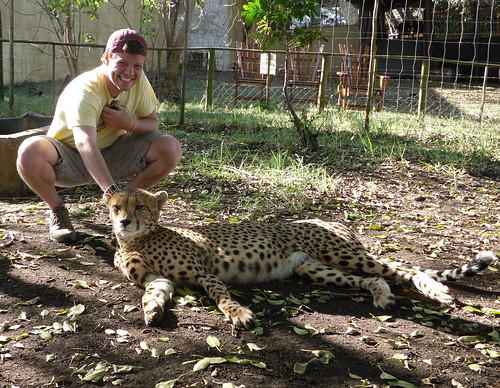
I petted a cheetah today. It came and laid itself down in front of us and our guide said we could come over and pet it.

I did.

It was strange.

Two of our hosts on the ground here in Eastern Cape took us to Inkwenkwezi Game Reserve today. It was amazing. Given the possibility of jetlag, movement was impressive.

While the nature was impressive, it was part of the conversation at lunch that began, again, to put the situation in Eastern Cape in perspective.

Talking to Charles and Nobubele who head the e-Personnel for all of Eastern Cape Province, we learned:

– Eastern Cape has 6,000 schools.

– The province is broken into 23 districts.

– That’s about 300 schools/district.

– Ten percent of all schools have a computer lab (PC).

– If the other schools have information communication technologies (ICT) it consists of a laptop and a digital projector.

– Many times schools’ principals will lock up the laptops (sometimes in their offices) because they don’t trust their teachers with the ICT.

– In order to get a lab, schools must put the infrastructure in place for the labs. That means everything from the tables to the power supply.

– One school received 30 computers but had power for 15.

A person begins to have perspective on what it means to work with educators here on building capacity for the integration of ICT in education.

You can take your cute workshop on digital storytelling and shove it or throw it or delete it or whatever-verb-you-choose it.

The new old ways of thinking don’t apply here.

New new ways of thinking are what are needed.

Working on that.

What if they don’t like me, again?

I’m imagining this to be easier to write given the lack of Internet connectivity. After three days of travel, we’ve arrived a Gonubie, Eastern Cape, South Africa.

While the others showered or settled in, I put on my running gear and ran down to the water.

Three and a half miles along the Indian Ocean at sunset with a full moon over the horizon turned out to be exactly what I needed.

I’m unsure what to expect from this first week of workshops. Though the e-Personnel here in Eastern Cape will have their own laptops, what I’ve read about the education system here has been bleak. I am, as always, waiting to be proven wrong.

One of the sessions I’m charged with leading this week is backward design. If your memory’s some sort of steel trap, you’ll recall I was Mr. Backward Design for last year’s projects in both South Africa and Kenya.

In Cape Town, we were met with resistance. Not resistance to the ideas or to me in particular, but resistance to what it resembled.

In preparation for this year, I did my research and found this report on the advent and predicted failure of Objectives-Based Education (OBE) in South Africa.

OBE is close to Backward Design (not the same, but close enough).

Handed down in the wake of Apartheid as a way to rejuvenate the South African education system as well as create an influx of creative, innovative thinking, OBE went along with attempts to reform the blatantly racist curriculum of Apartheid.

The study lists 10 reasons OBE will fail in South Africa. The study’s author is no dunce.

After the fact, this helps to put last year’s teachers in context and helps me to gear up for this year.

The piece that hung in my head – if you squint you can still see it hanging there – was the idea that OBE would also mean the advent of a slew of new jargon and terminology accompanying the new way of thinking. Add that to the existing structure of the South African classrooms and the paper argues teachers will overload and either reject OBE or implement it incorrectly, shaping what they’re already doing to fit what they understand OBE to be.

This last part stands at the crux of some of my concerns when working with teachers in a workshop setting.

I’m learning each year to push my students to think more deeply vs. trying to get shallow understandings of everything.

Professional development, though, is so scarce, it’s nearly impossible to resist the urge to throw everything into one week.

Looking at our schedule, I think we’ve a good start.

Tomorrow’s first face-to-face full-team meeting will help to flesh some of this out in my mind.

Sunday’s meeting with Charles (our liaison with the Eastern Cape Ministry of Education) and his colleagues will also bring a better understanding of what the participants here need and want.

So long as we’re working to those needs and wants, we’re on the right path.

Back to Africa (Almost)

I just finished drinking a Coke.

For those who know me, you’ll understand this is somewhat surprising. Then again, I’m sitting in London’s Heathrow Airport, so the Coke here is free of high fructose corn syrup, so I can drink without guilt – mostly.

It’s Day 2 of travel to South Africa.

After an hour’s delay at O’Hare, we boarded our flight.

Then, we sat.

We waited for some piece of cargo or another that was running late on account of multiple deluges that have been battering the Midwest this week.

Once loaded, we pulled away onto the runway.

Then, we sat.

One thing I’ve got to hand to our captain, the dude was forthright with the information.

“Folks, it’s Capt. You’llForgetMyNameLater here on the flight deck. No one seems to be taking our calls at the tower, but we’ll let you know as soon as we know something.”

It went on like this for a couple hours.

The Northern Corridor was shut down, and you know how that goes.

On the plus side, no one was seated near me, so I was able to “stretch out” while watching Leap Year. (If you haven’t, let me save you some time. Everyone ends up happy. Even the bar.)

My body and mind aren’t quite on the same page as to whether I’m tired or hungry or know what day it is. I’m hoping the 11-hour flight to Cape Town will sort that out.

I’m still sorting through my thoughts on the trip as far as expectations go. Most important – I never expected this. In my flurry of e-mails home to let folks know I’d made it through the first leg of the journey safely, I wrote this to a friend:

In other news, I’m going back to Africa – back. That’s crazy, right?

There are these moments when I stop and think about the little and big choices that led to this. I mean, think of all the decisions in my life that have afforded me these opportunities. Three generations ago, my mom’s mom’s mom was born on the banks of a river in the Oklahoma Territory. How’s that for perspective? Whoa.

So, that’s where my brain lives. A taste of this particular moment in my life before I sign off and head to Terminal 5 (I’ve been in the wrong terminal for a few hours now):

I’m sitting in Heathrow watching the World Cup on my way to Cape Town while chatting on Facebook with a friend in Nairobi. Oh, and yesterday morning, I woke up in Springfield, IL.

Youtube is killing my students[‘] [work]

The Gist:

  • My students created some amazing pieces of scholarly analysis using youtube.
  • The wider audience can never see it because of poorly-thought restrictions our systems and youtube’s systems have put in place.
  • It’s time for us to stop choosing ignorance over what it possible.

The Whole Story:

I’m actually supposed to be grading right now, but I’m angry, so I’m stopping.
I’m not even angry for the usual reasons.
My seniors completed what was their ultimate project of their English Studies at SLA.
The assignment was easy to explain:

  • Choose one of the top 10 most viewed youtube videos of all time.
  • Choose one of the six critical literary lenses (reader-response, gender, socioeconomic, new historicist, postcolonial, deconstructionist) we’ve explored over the last four years.
  • Apply that lens to the video and post it to youtube as a critical literary analysis.
  • For the created product, work in iMovie or use the annotation function of youtube.

The full project description can be seen here.

The work required them to utilize skills as readers, writers, and thinkers.
The problem, youtube – the algorithm, not the people – sees the work as a violation of copyright.
You would too, if you weren’t actually watching the videos to see what they actually are.
I wanted to make certain my thinking on this lines up with the legal requirements, so I went to Kristin Hokanson.
She said it all came down to two questions:

  1. Did the unlicensed use “transform” the material taken from the copyrighted work by using it for a different purpose than the original, or did it just repeat the work for the same intent and value as the original?
  2. Was the amount and nature of material taken appropriate in light of the nature of the copyrighted work and of the use?

She followed up with:
Fair use considers FOUR factors:

  1. the purpose and character of the use, including whether such use is of a commercial nature or is for nonprofit educational purposes;
  2. the nature of the copyrighted work;
  3. the amount and substantiality of the portion used in relation to the copyrighted work as a whole; and
  4. the effect of the use upon the potential market for or value of the copyrighted work.

In answer to the first question, yes. Rather than being a video for entertainment, the video is now a non-profit scholarly educational work. As for value, it’s the work of high school students. Some of the value is more, some of the value is less. Will any of these analyses break 1 million views? No.
In answer to the second question, yes. The students used all of the videos because they needed to show how the entirety of the text worked toward supporting their theses. In some cases, they augmented the work with outside slides in order to more fully make a point. Again, the idea here is for the viewer to experience the text concurrently with the analysis, pausing as needed to think more deeply. In the case of something like Miley Cyrus’ “Party in the U.S.A.,” I’m thinking this is a definite repurpose.
Realizing youtube would likely not discern between actual re-purposed non-profit educational work and a simple copy of the original work, I asked the students to submit their work as private videos and then share them with my account.
It was an attempt to keep their work authentic as well as alive.
For the most part, it worked. Then, students started coming in to class telling me their work had been taken down.
Let this be what I say:
For those who complain youtube is destroying culture or thought or any of the rest, this project re-purposed not only the videos, but the medium into a place for scholarly consideration of some of the most globally popular contemporary texts.
For those who argue the blocking of youtube in schools, look at this as a rudimentary example of what can happen when we empower students to think critically about and within online social spaces.
Many of the students worked diligently and thoughtfully on this assignment. If nothing else, they’re more thoughtful and aware of what they view and what it means for a text to be popular.
I’d show you this student work, but then youtube’d have to kill it.

Great American Novel-Off ’10 Explained

The Gist:

  • I wanted to try something other than the traditional teaching of a novel in class.
  • I wanted my students to think intertextually about what they were reading.
  • We tried the Great American Novel-Off 2010.
  • I will be doing it again next year.

The Whole Story:

This will be two posts. I’ll be reflecting in the next post. For right now, here’s what happened.

Each of my students in G11  was assigned The Great Gatsby to read on a schedule of their own with a set endpoint for the reading.

While they were reading, we discussed what constitutes the “Great American Novel.” What qualities would one expect? We looked at this Newsweek article on Ellison’s Invisible Man. We related discussions to the unit they’d completed on The American Dream in history class.

By the time we reached the endpoint for Gatsby, we were ready to draft our class qualifiers of the GAN. Each student came up with 10. Then, they got into groups of 4 and narrowed their collective 40 down to 10. Then, each group shared out what they thought to be the most important from its 10. We narrowed and finessed until we had a class 10.

As I’ve two G11 sections, this meant each section drafted similar but different qualifier lists.

Earth Stream:

  • American Concepts/Values/Goals
  • Realistic
  • Timeless
  • Relatable
  • Controversial
  • Self-Realization
  • Morals need to be questioned
  • Inspiring
  • Suspense
  • Diversity

Water Stream:

  • Relatable
  • Powerful Storyline
  • Timeless
  • Memorable
  • Reflective
  • Controversial
  • Life Lessons
  • Relating to American Culture
  • Says something about society
  • Emotionally stimulating

Again, similar, but not the same. We drafted the qualifiers Friday. Monday, the students received their book group assignments. With the exception of one group of students in each section, every student was assigned one of the 8 contenders for the title of GAN.

My intern, Hannah, and I worked to place students in groups where we thought they’d be both challenged and successful (not to mention interested in the content of their books).

Monday, they were able to make one and only one trade of books after doing a little research.

Then, we moved on. In their groups, they divided up the qualifiers and decided who would be tracking evidence of each throughout their novels.

They had three weeks to read their books.

Part of class time over those three weeks was given to reading. Part was group collaboration. The other part was dedicated to lessons on literary theory. Particularly, we examined the Gender (AKA Feminist), New Historicist, and Socioeconomic (AKA Marxist) lenses. To help me structure this, I turned to Deborah Appleman’s Critical Encounters in High School English. My professional library is all the better for its inclusion.

By the end of the three weeks, the groups were to build their cases for why each of there books best exemplified the GAN based on the class’ qualifiers.

As they compiled their evidence, each team posted their findings to an open Moodle forum so they could build counter-arguments. (Here’s a great example of what they did.) We talked about the idea of discovery in a trial situation and the goal of building the strongest case, not the most surprising. Some resistance here.

Two weeks ago, the cases started.

In Round One, each team had 10 minutes for opening statements, then 5 minutes of direct Q&A between the two, then 5-10 minutes of Q&A from my intern and me including questions submitted on note cards by students viewing the case.

For Round Two, each side had 5 minutes to open, with the same structure for Q&A.

Round Three, had the 5-minute openers, and the same Q&A with viewing students allowed to ask their questions directly.

In the final round, the winning challenger went up against Gatsby for title of GAN. As it was Gatsby’s first showing, the Gatsby groups got the original 10-minute opening time.

While viewing each case, students completed an evidence sheet documenting the evidence provided by each group as well as any relevant notes.

Starting Monday, each student will turn in a 2-3 page majority paper and a 2-3 page minority paper. Basic position papers, the majority paper will outline the reasons they agree with one of the rulings throughout the whole process. The minority papers will explain why they disagree with one ruling in the process.

My instructions on the papers:

  • Google how to write a position paper.
  • Use evidence you saw/heard during the case.
  • Include evidence posted on the forums.

On the Selection of the Novels:

I wasn’t quite sure how to do this. So, here’s how it ended up.

Initially, for one week, I published and asked others to forward on a Google Form asking “What is the Great American Novel?” followed by, “If you’d like to make your case, do it below.”

One hundred forty people responded.

From that 140, I took the top 8 most popular nominees. Noting the top 8 were decidedly white and male, a random sampling of SLA teachers spent over two hours after school one Friday debating what other 8 novels should be in the Sweet 16.

The Final 16 were:

  1. To Kill a Mockingbird by Harper Lee
  2. The Catcher in the Rye by J.D. Salinger
  3. Adventures of Huckleberry Finn by Mark Twain
  4. Portrait of a Lady by Henry James
  5. East of Eden by John Steinbeck
  6. For Whom the Bell Tolls by Ernest Hemingway
  7. Invisible Man by Ralph Ellison
  8. On the Road by Jack Kerouac
  9. Native Son by Richard Wright
  10. The Street by Ann Petry
  11. Seize the Day by Saul Bellow
  12. Little Women by Louisa May Alcott
  13. Song of Solomon by Toni Morrison
  14. The Brief and Wondrous Life of Oscar Wao by Junot Dîaz
  15. The Lone Ranger and Tonto Fistfight in Heaven by Sherman Alexie
  16. Slaughterhouse Five by Kurt Vonnegut

The 16 were posted and pushed out as a new google form asking respondents to indicate their first and second choices. After a week, each first-choice vote earned a novel 2 pts. while a second-place vote earned it 1 pt.

Three hundred thirty-seven votes later, the top 8 became the contenders:

  1. To Kill a Mockingbird
  2. The Catcher in the Rye
  3. Adventures of Huckleberry Finn
  4. East of Eden
  5. Invisible Man
  6. On the Road
  7. Little Women
  8. Slaughterhouse Five

And there it was.

In the next post:

  • How it went.
  • Student reaction.
  • Changes for next year.

Writing out the window

The Gist:

  • My students are writing what they see.

The Whole Story:

They sit in windows with journals and pens and pencils in hand. Many of them plug out the sounds of the building with iPods.

They appear to be daydreaming. Really, they’re completing an assignment.

At this moment, my class is scattered around the building – writing.

At the top of the period, we walked en masse to the end of the third floor hallway.

I pointed across the street to one of the lofts whose windows give their inhabitants a kind of zoo-like aire.

“Who used to live over there?”

“Elliptical Guy.”

“Yes, Elliptical Guy. For two years, I watched Elliptical Guy work out whenever he was home. No matter the time of day. I don’t think I ever saw him eat or sit on his couch.”

Small giggles.

“Eventually, I started wondering who he was. Why was he so adamantly exercising? Why did it seem like he was never losing any weight?”

The odd, “Me too.”

“Then I started wondering whether he was working out for himself or someone else. Was there a guy or a girl he was trying to win over? Finally, I had to make Elliptical Guy a story. I had to make him into someone real in my life. It made the constant checking up less creepy; it made him a part of a story I was writing and reading all the time.”

Now, take your journals. Find a window. Look out. Find someone or something that tells you a story. Write that story.

As I’ve written this, they’ve started to file back in.

It’s time to find out what they’ve read in the world.

Could you do this? Making music tell a story

The Gist:

  • Students in my Storytelling class are now working with music.
  • What we’re doing isn’t explicitly stated in the state standards.
  • No part of me believes this project isn’t helping them to be better readers, writers and thinkers.

The Whole Story:

Looking at the syllabus for my Storytelling class, I noticed I’d planned for poetry to follow our short story unit. Taking the temperature of the students, I decided a course adjustment was in order.

Instead of poetry, we’re working with music-without words.

To start things out, I needed to stand their expectations on their ears.

Everything was to be cleared from their desks. I distributed blank paper.  Crayons, colored pencils and markers laid sprawled on a central table.

“I’m going to play 10 stories for you,” I said, “You need to draw or write the story as you see fit. You’ll have 30 seconds between each story to finish before we move on.”

Papers were folded, coloring utensils collected and chairs situated just so.

I pressed play.

“Kyrie” from Mozart’s Requiem wafted from the speakers.

“I’ll let you know when there’s one minute left of each story,” I said.

They started drawing and writing the stories they heard.

When all was done, we’d listened to:

“Kyrie” from Mozart’s Requiem

“Fanfare for the Common Man” by Aaron Copeland

The theme from the 60s BBC show The Avengers

Verdi’s “Grand March” from Aida

“Heart String” by Earl Klugh

“Ode to Joy” from Beethoven’s Ninth Symphony

The tango from Scent of a Woman

Apotheosis’ take on Carl Orff’s “O Fortuna”

The theme from The Rock by Hanz Zimmer

The theme from Pirates of the Carribean, also by Hanz Zimmer

Thirty seconds after the last story, I told the class the story of riding in the back of my mom’s Nissan Pulsar when I was in first grade and we lived in Kentucky. When we’d drive back to Illinois in the middle of the night for holidays, each song that was in heavy rotation on whatever light rock station she was listening to was burned into my memory.

I played “Everybody Wants to Rule the World” by Tears for Fears and explained, for me, that song was about being 7 and riding from Kentucky to Illinois more than it could ever be about John Hughes’ 16 Candles.

Then came the assignment. They’re to re-tell the stories they wrote after the first day of class as a non-vocal musical track. They may compose something original or remix and mash up other tracks.

The only allowable vocals are unintelligible words like Orff’s Latin lyrics in “O Fortuna” or something along the lines of a doo-wop riff.

I’m excited to hear what they create. My hope is this assignment will stretch their thinking. I’ve tried it, it’s tricky.

Nowhere in the Pennsylvania English Curriculum does it direct students to be this kind of writers. Nowhere does it ask them to read texts as music. For that matter, the draft of the Common Core Standards doesn’t include anything like this.

I could massage a few of the standards into place, but either the assignment or the standard would end up inauthentic.

That said, I have no doubt what my students will be doing is a valid, challenging, authentic form of consumption and creation. They’re reading, writing and thinking in a way no test could measure or equal.

It’s going to be difficult, messy, frustrating and beautiful.

I can’t wait to hear what they create.

@EdPressSec I would love to talk to you

Dear @EdPressSec,
I’ve left numerous messages via voicemail to see if anyone has had a chance to look up the information I requested regarding the Proposed FY2011 budget and funding of the National Writing Project.
The last I heard, someone would be getting back to me by the end of the day. That was Friday, March 11.
I don’t mean to be difficult, truly.
I have three starting questions:
As I said in my last two messages, I’m heading to D.C. this afternoon. The nice folks at the NWP have invited me to join them for their Spring Meeting. I’m happy to attend and hear how they are dealing with the potential elimination of direct funding of a national organization that has shown a positive impact on the teaching and learning of writing in America’s schools.
Thursday, I’ll be sitting down in the offices of Senators Specter and Casey to discuss the NWP.
Aside from those meetings, my schedule is free. If you have a few minutes, I’d thoroughly enjoy the chance to sit down and discuss my questions. I’ll even bring the coffee.
Again, I look forward to hearing from you.
Sincerely,
@MrChase