 As promised, I’ve been working on processing the first few days of our time here in CPT.
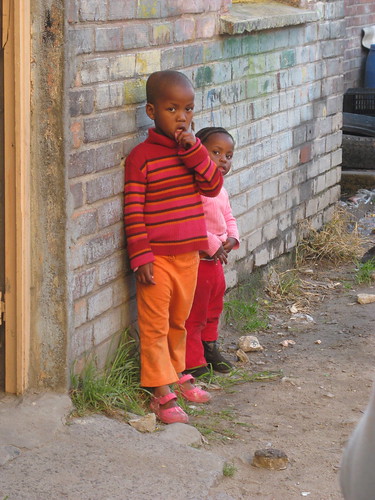
Here’s a thing that struck me. It struck me strongly and quickly. On our tour of Langa Township, our guide Khonaye commented on the children running around. “You’ll notice they’re everywhere,” he said. “Children here will play 5, 6 blocks away from their homes without danger.”
They don’t need to worry about abduction, molestation or violence, he told us.
The community policed itself.
We stood incredulous. Why don’t they have to worry? How does the community police itself?
“If someone does something, there is vigilante justice.”
Let that one settle in.
Now, I’m no proponent of vigilanteism, and I’m all for following the letter of the law. That said, the most heinous thing I can fathom is a crime against a child.
Here, where three families would co-habitate in one room, the children were safe.
In the suburbs of some of the squeaky cleanest of America’s communities, parents forbid their children from crossing the street alone.
Amber Alerts happen too frequently. They happen at all.
In Philadelphia, violence directly impacts my learners with a disturbing regularity.
This is not to sugar-coat things. One of the first things Captonians will tell you is their city has the most violent crime in the world. Mugging stories are omnipresent.
Still, within the cobbled together communities where corrugated metal is a frequent building material, the children can play safely.
It’s far from perfect, but it’s striking.
Given such community protection of the children, where is the ire when thieves steal entire labs worth of computers or dig up and steal the wiring and ethernet cable? These tools offer gateways allowing learners access to the rest of the world. Ignoring computers, where is the community fundraising to provide pencils, paper, books and erasers so that teachers can create gateways allowing access to the worlds that exist within learners’ own minds?
I’m not dictating what should be done. I’ve seen the dangers of outsiders pronouncing edicts for improvement on existing systems.
What I’m trying to do here is think aloud to bridge the disconnect going on in my mind.
Nothing is simple.

 7-14-09
 Wikipedia
 In South African educational parlance, teachers don’t teach “students,” they teach “learners.” I like that.
 Something lighter today. It’s 12:15 AM as I write this, and we’re to be leaving for the school at 7:15 AM. My body’s been struggling against a restful night’s sleep for the past two nights, so I’m hoping to wear it down tonight. Clearly, it will have no other choice than at least one complete REM cycle. Yes, this is the plan of a 7 year old. Today was beautiful. As the weather was sunny and the clouds continued to hold back, we took advantage and visited Table Mountain. We took the gondolas rather than making the 4-5 hour hike each way. Next time, I guess. The mountain was tremendous and different than the others I’ve visited in the last 6 months (San Juan, Grand Canyon, Sedona, Blue Mountain). It was pushed up from the sea millions of years ago but remained only an island until the water receded. Most amazing was standing at a precipice and watching the clouds from below fly up the side and overhead. Part of something. On our return trip, we were able to stop by the Pick ‘n’ Pay to purchase the little things. Washing my hair with shampoo tonight rather than lathering with a bar of soap felt indulgent. That was nothing compared to using proper toothpaste to replace the miniscule tube I’d squirreled away from the plane ride. The bulk of the day, however, was spent planning tomorrow’s workshop in detail and scoping out the rest of the week. It was the first time the 6 of us sat in the same room to ply our craft in a focused way. As expected, the dynamic took us a bit to figure out. It was like working as part of a beginning faculty once again. I like that feeling. The biggest challenge for me is holding true to the concept that it’s the ideas, the ways of thinking that can make the most impact here. In the end, if a teacher we work with here isn’t proficient in using PowerPoint, I won’t be worried so long as she has started to see her colleagues in a collaborative life or has begun to let inquiry drive her classroom. With so much to talk about and only a week with this group of educators, I’m reminded of the lure of direct instruction. Fitting the core of ICT tools into a week feels like designing a micro-world history class. If they could just sit in the room, listening rapt with attention as each of us took a turn relaying important information, think how much we could teach. How much would they learn? Tonight, I’m closing with a question. If you were to design a week-long course in ICT, what would be at the top of your list? What would be the first things cut? What would be your biggest focus? All right, I’m closing with three questions.
 The goal for my writing whilst I’m here has to be to get it all down whilst I’m still to close to my experiences to have perspective.
 After nearly 24 hours of travel, the