 I think I may have stumbled on to one of the causes of the high rate of new teacher attrition.
Wednesday night, I finished session 4 of 5 of the School District of Philadelphia’s New Teacher Induction program.
My blood pressure wasn’t as high as it had been for sessions 1 and 2. I got out of session 3 by presenting with Marcie at Penn State’s 1:1 Laptop Conference. Coincidentally, it was the session where we talked about whether or not technology integration was important to differentiated instruction. (Had I been there, I’m pretty sure my eyes would have bled or I would have rocked back and forth in the corner humming “The Farmer and the Dale.”)
I had to go through new teacher induction my first year in Sarasota. The process took the entire year. SRQ uses a mentor/mentee model where novice teachers are teamed up with veterans. I’m pretty sure my mentor didn’t like me because our meetings usually consisted of the following:
Her: How you doing?
Me: Fine.
Her: Good. I guess I better initial those papers.
It was a synergy to make Stephen Covey proud.
Philly’s induction, like Philly’s core curriculum, is scripted, minute-by-minute. You can imagine what that does to class discussion. Not surprisingly, this also means, we have avoided the topic of differentiated instruction.
Wednesday, as we began looking at data and AYP and core curriculum and needs assessments and PSSA trend analysis and everything else, I could take no more.
“This is insulting,” I said, “We are all professionals, we have been trained as teachers.”
The instructor/facilitator/swami agreed, but pointed out that our ability didn’t mean a few bad teachers didn’t enter the profession.
“Yes, but I’ve had a few weeks with the 20 people in this room, and I’m pretty confident we’re not those teachers, but we’ve allowed for the building of a system that treats us as though we are.”
At this point, the train had jumped the tracks.
It was wonderful. We had an honest discussion of race and the history of Philadelphia, about systems and the like. For the first time, the car ride home was filled with discussion not of how things could have gone, but what things can become.
I’ve more thoughts on this swimming around. They’ll appear shortly, but the crux of it is this: I know new teachers need support in their first two years or they’ll revert to teaching the way they were taught when they were in school. But shouldn’t that support be dynamic? Shouldn’t that support be about what teachers need? Shouldn’t we be engaging each other in the kind of dynamic discourse we’re hoping for in our classrooms? Shouldn’t we?
More later.
Year: 2008
Oh, The Paper

For those who are unaware, SLA is a textbook-less school. More to the point, we’re a paper textbook-less school. It is a beautiful thing. Truly.
Today, preparing my 10th graders to create the Action Plan portion of what they’ve dubbed the “Change the World Project.” I created a Word document complete with step-by-step instructions with guiding questions. It was good teaching. I threw the doc up on our Moodle page and worked the kids through the prep they needed to undertake the assignment. Then, it happened, Moodle was down. The Moodle (sometimes we call it that in our Seinfeldian way) was down.
If I may drop some sarcasm on you, one of my favorite moments in a class is when something simple doesn’t work and hands shoot up and the kids start shouting my name like it’s a button for an elevator that won’t show up.
I say all this because it’s the thing about actual textbooks, they don’t crash. That’s it. I’ve worked in a 1:1 school in some incarnation or another for almost three years now. I love it.
They crash. Yes. You know what, though? They come back.
A few things can’t be done easily with paper textbooks: upgrading an entire curriculum in a day, patching, getting the most timely information possible, receiving information free of charge or corporate filtration, researching innumerable points of view, differentiating instruction on a dime…
Here’s the rub, when a kid forgets his book, that kid just needs to share with his neighbor. When an online book crashes, sadly, it falls on the shoulders of a schools techies. The shift or added layer of responsibility that comes with paperless texts can be difficult to maneuver. That, though, is why we are the teachers. Since the days of slate tablets, Plan A has failed and Plan B has been picked up on the fly.
The point is this, paperless books are not perfect, but they are far better than the tools of old. By the time I’d printed the pages I needed for today’s lesson, The Moodle was back up and what I’m sure was half an acre of Brazil had been clear cut. My own personal Change the World Project?
More later.
I just like this
I stumbledupon this, and it made me smile.
More later.
Going Deep

A Pownce from a student yesterday:
[S]o [C]hase, when [I] google stuff to find links to help me out for my posts [I]’m starting to get my own work!
[It’s] driving me crazy. Just wanted to tell you for no reason.
[It’s] driving me crazy. Just wanted to tell you for no reason.
She’s not the first person to find herself when searching for new information on her benchmark project. I was hoping this would happen. I could have preached the shortcomings of the almighty Google, but they wouldn’t look anywhere else until they truly needed it.
They’ve started needing it. They’ve started needing the deep web. We started talking about it today. A somewhat convoluted metaphor of Google being like the garbage men on my block and deep search engines being like the little old lady who picks up the actual litter started things off.
Wikipedia’s entry on the Invisible Web says this about its size:
In 2000, it was estimated that the deep Web contained approximately 7,500 terabytes of data and 550 billion individual documents. Estimates, based on extrapolations from the study entitled How much information 2003?, from University of California, Berkeley, show that the deep Web consists of about 91,000 terabytes. By contrast, the surface Web, which is easily reached by search engines, is only about 167 terabytes. The Library of Congress contains about 11 terabytes, for comparison.
Philly schools have a subscription to EBSCO. It’s one of the best kept secrets in the district. Now, EBSCO got me through college. Fully text searches were the reason I spent minimal time in the library (sorry Doug Johnson). Showing it to the kids today, though, I felt like I was handing them a Vespa in celebration of their 16th birthdays. For some, it got the job done. For others, more was needed.
Enter “99 Resources to Research & Mine the Invisible Web” and a tutorial from Berkeley on using the invisible web.
Not all of the tools were right for all the students – I know, I was shocked too. It’s weird when they learn and see that it’s important.
More later.
Seeing Themselves
Part of the “Change the World” project that I hope you’ll participate in and comment on here or here requires my kids to write 5 reflective posts about their progress.
The first was due last week. I wasn’t sure what to expect. While my students’ ability to write about their lives in their journals has been steady, I was worried asking them to reflect on their work in such a focused manner might give them problems.
Turned out my worries were misplaced. Julia writes:
From the explanation of this project as a whole, it seems unbearable. Completely impossible. My expectations were that there was no way I could do it. When I first looked it over, I didn’t even know how or where to begin. At this point in time though, I’m pleased with the progress I’m making on this project.
She goes on to make certain her audience doesn’t confuse her progress with ease. Still, it was her last three sentences that got me:
I think the obstacles are there, but not impossible. Mostly, I think that as a 10th grade English class, we are doing something different and amazing. That’s the most satisfying progress so far.
She’s excited about learning. While not every student is putting his or her excitement in quite the same form, something different is going on. Over the last few classes, I’ve answered questions about finding better sources, better change agents, writing letters, correctly formatting direct quotes…I mean a 10th grade student to asked how to set up a direct quote.
Sometimes, things go ok.
More later.
The problems we face
Ms. Hull and I presented at PETE&C today. The coming “blizzard” likely affected attendance at our last session of the conference. Thank you weather for providing scape goat.
To get people thinking and break the Sit & Get mentality, we had those in attendance think of the 1-3 things keeping their building from breaking through to greatness.
They shared with the people sitting next and reported out.
Here’s the list they generated:
- Staff resistance
- Keeping current
- Lack of community support
- Lack of a vision (clear vision)
- Administration road blocks
- Money $$$$
- Lack of technicians
- Lack of solutions
- Deciding – dealing with overload
- Blocking the server – firewalls
- FEAR
- Lack of voice for teachers
- Need for communication from techs to teachers
- Common language
- Sense of community
- Time
- Pride
Read the list again – I had to. The topic of the presentation was “Planning the 21st Century School.”
Aside from blocking the server, these are 20th Century problems. Replace server with “texts,” “discoveries,” “evolution,” etc. and you’ve jumped in the Way-back Machine.
My invitation to you – pick a problem, any of the above or one specific to your building, and comment with a possible beginning to a solution. What can be done?
More later.
A outline for changing the world
[Below is the description of the project I last posted about.]
Q3 English Benchmark Description
Social Action Project
Alignment with SLA Core Values
Inquiry: What is an issue affecting you at the local, state, national or global level that you can work to change?
Research: Identify the social, historical and scientific factors surrounding this issue. Identify realistic steps that can be taken to create positive change regarding this issue. Identify a change agent with capital (social, political or economic) necessary to work to improve the status of your issue.
Collaboration: While conducting your research, you will identify and subscribe to at least three RSS feeds from viable sources regarding your topic. Throughout the quarter, you will synthesize your information in the form of at least 10 blog posts to your SLA Drupal blog. Two of these posts must analyze the topic through the scientific lens, and two of these posts must examine the topic through a sociological or historic lens. You will also be responsible for subscribing to and commenting on the blog postings of two members of your stream as well as two members of the opposite stream.
Presentation: Based on your research and synthesis, you will create a 3-5 minute “elevator pitch” designed to convince your identified change agent to act on your issue. You will also create a research-based action plan outlining realistic steps that can be taken to improve conditions surrounding your issue.
Reflection: Given the cumulative nature of the understanding gained through this project, you will post 5 reflective posts charting your progress throughout the quarter with the fifth post to follow completion of the Presentation portion.
Skill Sets
Necessary Tech Skills:
- Posting blog entries to Drupal
- Searching and identifiying reliable information sources
- Subscribing to RSS feeds
Necessary Social Skills:
- Contacting change agent
- Arranging face time with change agent
- Providing productive feedback and support to peers
So…about the world, seems like it’s time to change it
My mom likes to tell the story of the first time she read me the biography of Martin Luther King Jr. I was all of 7 or 8 years old. As she tells it, there was a bit of a paradigm shift involved. I marched back and forth in my footie pajamas explaining to her that “it was wrong, why would someone kill him? Why would people hate other people because they looked different?” It was my first run in with some of the big questions that unfortunately continue to trouble the world.
Two weeks ago, we started the third quarter at SLA.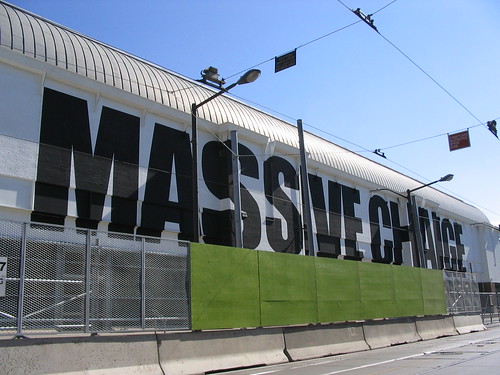
As I last posted, I seem to have challenged my kids to change the world in 9 weeks or less.
Friday, they started posting.
The basics are this:
- Pick a problem.
- Build a feed reader with at least three feeds on your problem and search/bookmark viable sites.
- Throughout the quarter, write 10 informational posts using the information from your reader/bookmarked sites.
- Throughout the quarter, write 5 reflective posts on your progress.
- Draft an 3-5 minute “elevator pitch” for a possible change agent to show you know what you’re talking about.
- Draft an action plan around a realistic solution to the problem you’ve selected.
- Meet with an identified change agent and present your pitch and action plan.
Friday, their first two posts were due. I’ve started reading them. Some good work from first-time bloggers. The next step is to help them build readerships. While I’m asking teachers at SLA to read and comment on posts regarding their areas of interest, I issue this call to anyone out there – read here or here and help teach our students.
I’ll be linking the formal project and rubric descriptions soon.
More later.
Untitled
 My tenth graders created podcasts in the vein of This American Life. The results were varied, but by-and-large, impressive.
I’m speaking of the quality of the work, but also of the investment of the students. For the first time, truly, my students were engaging in work that meant something to them and a larger audience. We’ve blogged before. We’ve used wikis. Blah, blah, blah.
This assignment, however, was something else. They owned this. I took my hands off the wheel and trusted they’d know where to go.
One student who moved with his family to the states from Bangladesh five years ago interviewed his family on the decision to move an entire household. He interviewed his family in Bengali and had another Bengali student record a translation over the speaker. The work was fantastic and he put more time into getting the story right than I’ve seen him put into any other assignment this year. As an emerging language learner whose mastered the conversational vocabulary, but is still developing his academic vocabulary, he found a voice in this project that that has continued to augment his contributions to class discussion.
This quarter, a new project is at hand – Change the World. Admittedly, it didn’t start out with that charge. After explaining to my first section of 10th graders that they were to pick a problem in the world, work to talk to a possible change agent and present that change agent with a feasible action plan, one student raised her hand and asked, “So, basically, you want us to change the world in 9 weeks?”
I paused for a beat and replied, “I guess so, yeah.”
We’re two weeks in and their first blog posts are due at midnight tomorrow. Each student is using his or her SLA Drupal account to document the process and information. All the posts are aggregated on the class pages. Their topics are wide-ranging and sights are set high.
If you’ve got a second, drop by Gold or Silver and leave a comment. They’re finding feedback invigorating. Heck, I’m finding feedback invigorating.
More later.
One of my favorite things to do
 It’s Monday night. Here I sit in my PJs with my gradebook up-to-date. I decide to reward myself.
I open the student contact file on my computer along-side my gradebook and pic a student who’s doing well in class. I look up the number, dial and wait.
The voice on the other end clearly does not recognize my Floridian number on caller ID.
“This is Mr. Chase,” says I, “Milana’s English teacher.”
“Yes…” a clearly uncertain pause.
“I was just calling to let you know how great it is to have your daughter as part of our class. She’s one I can count on for insightful comments, and I’m impressed by how hard she’s working on the Quarter 3 benchmark project.”
The conversation goes on for a few minutes more. We talk about how I joined SLA after the year started – that’s why she doesn’t remember meeting me. We joke about keeping the call between the two of us so as not to inspire false confidence in her daughter.
Before we hang up, though, she says, “I don’t know if this something you do personally as a teacher or what, but keep it up. This is one of the best phone calls I’ve gotten in a long time.”
It’s the best way to end a Monday I know.
When I was in Florida, I tried to make two positive phone calls home before I went home each day. I developed the habit after Hal Urban spoke at my first school.
Much can be said about setting the tone with parents, building relationships, etc.
That’s part of why I do it, but it’s not the bigger why.
I make those phone calls home because it makes me feel better. I make those phone calls because it pushes me, everyday, to look at the best of my students. In the hectic frenzy of any given school day, the least I can do is make certain I catch the best of my students.
No matter what happened before, the words, “This is one of the best phone calls I’ve gotten in a long time,” made this a good Monday.