118/365 Mission Hill is What Theory Looks Like in Practice #YearAtMH

I’ve been asked by Sam Chaltain to contribute to the conversation over at EdWeek around the series A Year at Mission Hill. I’ll be offering a take on each episode and interpreting some of the research that might be relevant and trying to make it practical. This piece was originally posted at EdWeek.

One of the great joys of A Year at Mission Hill is the glimpse it provides of the entirety of the teaching and learning experience. In Chapter 5, we are provided continued access to both the planning and implementation sides of teaching as we see and hear teachers planning lessons around a school-wide investigation of Chinese culture.

We find 2nd/3rd Grade Teacher Jenerra Williams (1:40) discussing the needs of her students in a planning meeting that draws a connection between both her professional expertise and the place of educational theory in the classroom, as she explains to her colleagues that they must take into consideration the cognitive development of their students while planning the introduction of new concepts.

There is beauty in Williams’ informal connection to Jean Piaget’s theory of cognitive development and its application to the “concrete” thinking Williams and her colleagues notice as prominent in their group of students.

While this episode is primarily concerned with the artistry and learning of the students, it’s worth pausing to appreciate the artistry and learning of the teachers as well. Williams weaves formal and informal assessments of students into her knowledge of cognitive theory to make sure the team is pacing the learning in such a way as to provide access for everyone.

So too, is there beauty in Kindergarten and 1st Grade Teacher Kathy Clunis D’Andrea’s interaction with a student (3:09) who has a “great idea.” Not only has D’Andrea created a space where her students continue to feel the safety and freedom to share such ideas, but her response shows a dedication to letting students play such ideas out in their own heads. D’Andrea’s reaction to the student is not to judge, criticize, or question the idea, but merely to repeat it back to him as a literal sounding board and then keep the space open for him to build on it publicly from there.

Such moments are excellent embodiments of Eleanor Duckworth’s ideas of “messing about” as described in her book The Having of Wonderful Ideas. They are also spoken to in Art Teacher Jeanne Rachko’s description of how she sees her role in the classroom.

Rachko’s dedication to letting students “discover who they are as artists,” and “empowering them in their own choices,” is revealed not as some soft bohemian philosophy, but one borne out in research and educational theory.

In a sense, Rachko is co-discovering who her students are alongside them. Such practice answers the call made by Dave Rose in his book Why School?, when he wrote that “teaching carries with it the obligation to understand the people in one’s charge, to teach subject matter and skills, but also to inquire, to nurture, to have a sense of who a student is.”

Such an obligation is fulfilled in each of the considerations Mission Hill makes because the school attends to both the needs and the curiosities of its students. It motivates by creating situations that invite students to play and include the four key tenets of situated motivation as described by Scott Paris and Julianne Turner: choice, challenge, collaboration, and control.

Making room for each of these components, co-discovering who their students are, and applying educational theory to what they discover allows Mission Hill’s teachers, and others like them, to make practical decisions that are artfully executed.
117/365 How Can Schools Meet the Developmental Needs of Children? #YearAtMH

I’ve been asked by Sam Chaltain to contribute to the conversation over at EdWeek around the series A Year at Mission Hill. I’ll be offering a take on each episode and interpreting some of the research that might be relevant and trying to make it practical. This piece was originally posted at EdWeek.

Of the many poignant moments in Chapter 4 of A Year at Mission Hill, my favorite is of teacher Jada Brown sitting and rocking a student (1:50). The image, as well as the rest of this episode, helps to draw focus to the physical and socio-emotional needs of students in all schools. Sadly, these are the needs most often lost in the current conversation of how we can build the sorts of schools our students most sorely need.

As Mission Hill’s teachers repeatedly point out (and as any teacher who works with children knows), students who step into our classrooms do not come into existence the moment they cross the threshold into the school building. They bring with them all of their experiences, all of their memories, and all of their needs as developed over the course of their lives up to that point.

And, they are children. While the majority of adults can filter these things as they move through their days socially and professionally, students often do not have such filters in place; they are at various stages of developing the tools needed to manage their interactions with others and intrapersonally.

While full-inclusion schools such as Mission Hill are also working with students with more pronounced needs around the management of their emotions and the filtering of stimuli, it’s worth noting that this work is important for all children.

Learning is better when we attend to the needs of the whole child.

Such is the reasoning behind ASCD’s Whole Child Initiative. Launched in 2007, the Initiative is designed to widen the narrowing thinking about what it means to educate children and prepare them for their futures based on the following tenets:

  • Each student enters school healthy and learns about and practices a healthy lifestyle.
  • Each student learns in an environment that is physically and emotionally safe for students and adults.
  • Each student is actively engaged in learning and is connected to the school and broader community.
  • Each student has access to personalized learning and is supported by qualified, caring adults.
  • Each student is challenged academically and prepared for success in college or further study and for employment and participation in a global environment.

Recognizing that sending these tenets out into the world alone would only help a certain segment of the teaching population, ASCD and its partner organizations have compiled research and action plans to help teachers and school communities begin the process of setting their unique courses to better supporting the children in their care. These are the types of conversations we see embedded throughout the practice of the teachers at Mission Hill.

Returning to the image of Jada Brown comforting her student in the rocking chair, it is important to look more deeply at what is happening in the scene. Yes, there is socialized comfort at play. Brown is offering a safe mental and emotional space for the student and likely offering helpful verbal de-stressors.

Another key component often overlooked or never considered in most schools and classrooms is the balancing of the student’s sensory diet Brown is offering through her positive touch and the rhythmic rocking of the chair. In short, she is helping to balance the chemistry of the student’s brain toward the goal of greater control of behavioral outputs. It’s the kind of work occupational therapists like the late Bonnie Hanschu do every day: considering how students’ tactile, proprioceptive, and vestibular systems can be brought into greater harmony. Sadly, it’s also the kind of work many teachers never hear about in their pre-service or professional development work.

For more information on occupational therapy, try these resources compiled by the American Occupational Therapy Association.

Seeing the students in our care as their whole selves and building our understanding of how strong physical, sensory, and socioemotional supports work together to build clear pathways to academic success is work worth doing. More than that, it is work that must be done.

116/365 Find Something Interesting, Ask Questions

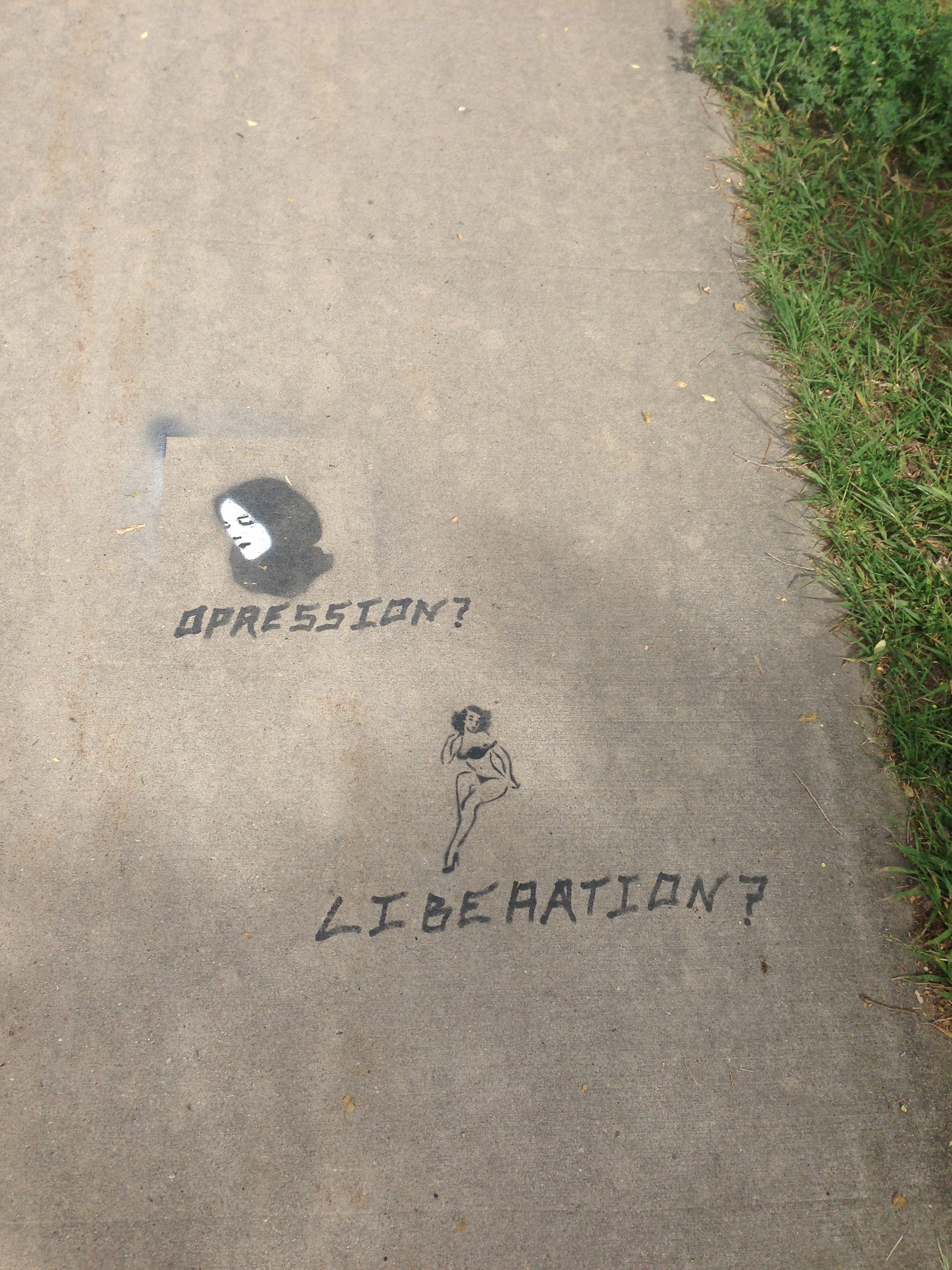
oppression/liberation

On the pavement of a running and biking path are two images left by an anonymous stencil artist. The first is a profile of a woman wearing a hijab. Slightly lower and to the right of this image is another painted, stenciled image of what could easily be a rendering of an image of a mid-twentieth century pin-up girl.

Below the woman in the hijab is a single word “Oppression?” and below the pin-up girl, “Liberation?”

While some might see these images and bemoan the defacement of public property, in reality there is much more to be found in this small stretch of sidewalk.

This is a quarter’s worth of deep curriculum here that could push the most precocious students to challenge their beliefs about the world.

  • What is public property?
  • What does it mean to be liberated?
  • What does it mean to be oppressed?
  • How is gender defined across cultures?
  • How does your view of the world influence your understanding of how other people live?
  • What does art do?
  • What should art do?
  • Who decides the value of art?
  • When might it be acceptable to break the law?

The questions are potentially never-ending. They should be. Good, thoughtful teaching and learning is a process more generative of questions than hard answers.

In the schools we need, the world provides a curriculum rife with opportunities for questions, and the people within these schools recognizes these opportunities for what they are and could be.

This image on the sidewalk need not come packaged in an aligned, approved, and adopted curriculum. It need only come from an individual who has developed the habit of mind that allows, “Hmmm, that looks interesting,” to be followed by, “I’ll take a picture of that and see what we can do with it.”

In the simplest of terms, this process is probably perpetrated by classroom teachers. At least at first, this is likely the only way to cultivate such curiosity (especially given the educational and curiosity neglect many children face in schools). Given time, though, this will become the culture of the classroom. Given more time, it will become the culture of the school.

Most importantly, given space, this will develop an understanding that neither classroom nor school is defined by the walls of a building or a designations outlined by a district.

For any of the questions listed above, the only materials necessary for diving down the rabbit hole of inquiry is a device to capture and share the image and then not much else. If the questions are being asked in a school with wi-fi access and a “bring your own device” policy, excellent. If it is a school with access to 1:1 computers, superb. A computer cart or lab? Tremendous. A library within the school or down the street? That’ll do nicely.

In the same way that schools must learn to follow questions and allow them to generate more questions, they must consider resources as generative as well. After, “What are our questions?” teachers and students must ask, “How will we find answers?”

Some spaces with over-abundant resources and close community ties will find the process easier to navigate. Those schools with limited access will find it more difficult. What experience has shown and what can always be relied on is the fact that a good and worthwhile set of questions communally generated can overcome however easy or difficult the process may seem.

If students need to find answers, they will find them. This will not change the difficulty of the process in the most isolated schools of Appalachia or the poorest of urban schools. It will, however, make that difficulty surmountable.

A camera and the openness for questions. From there, it’s hard to imagine anything standing in the way of learning.

Learning Grounds Ep. 019: Scott Nine discusses the Lessons Learned through ‘A Year at Mission Hill’

In this episode, Zac talks with Scott Nine, executive director of the Institute for Democratic Education in America about Scott’s learning throughout the web series A Year at Mission Hill.

Play

114/365 All the News that’s Fit to Align with What We’ve Already Read

dead newspaper

I’m just getting to today’s ASCD SmartBrief in my inbox. I don’t often have time to run through it, but it’s summer, and such extravegances are permitted.

The subject line today, “Principal: Testing is about measuring knowledge, not meeting deadlines.” The link leads to this Education Week commentary from Ryan McLane, a junior high school principal in Utica. I’ll leave the content of McLane’s piece to him.

This isn’t about that.

The second story is about 21st-century skills and a Gallup survey sponsored by Microsoft Partners in Learning and the Pearson Foundation.

Third? A story on Texas schools uncovering knowledge that taking kids on field trips helps them think about what they might want to do after school.

These are the top stories under “Learning and Teaching” for the day. While they speak to the trends of the American education landscape, but they do little to push at the boundaries, challenge popular beliefs or uncover new ground.

The other categories in the brief follow a similar pattern.

My ire was probably its highest under the “Whole Child” section which featured a single story on the pantopticonian increase in demand for survelliance cameras as the answer to school safety concerns followed by “Wyo. considers training teachers to recognize students who are at risk of suicide” under a sub-sub-heading.

To say this reflects a saddening national conversation would be an understatement.

Perhaps I’m asking too much of a SmartBrief as well as showing a naive hope that what remains of the Fourth Estate might take on the mantle of helping their audiences critically evaluate the objects of their reporting. At the very least, it would be nice to see any continuing coverage of school closings taking place across the country and how they might disproportionately effect students from different ethnicities differently.


Special thanks to my English teachers who, even though we were firmly in the 20th century, helped me to develop the distinctly 21st-century skill of critical thinking and reading closely.

113/365 I’m Starting a new Adventure

Bud Hunt just got another reason to show up at work in the morning. Starting this fall, I’ll be joining Bud and the rest of the team in the St. Vrain Valley School District as a District Technology Coordinator. It’s a position that will allow me to call on my experiences as a classroom teacher, training in the policy sector, and the work I’ve  done with school districts and teachers around teaching and learning.

I am excited for it, and excited to be back in public schools again. Certainly a departure from heading a classroom as a teacher, this is still much closer than my last two years of graduate study.

Speaking of those, what’s to become of my doctoral program?

As of right now, it is on hold. I’m availing myself of the option of taking a year away from the program to decide if I want to continue in whatever capacity. I think I know my answer now, but I want distance and perspective so that I might be more certain.

I’m stepping away from the program because I want to be more useful. While I realize some graduate studies are inherently practical and relevant in their implications, I’ve not felt that this year after nearly a decade of knowing it in the classroom each day.

I’m also not certain I’m to be an academic. After hearing my thinking on the subject a few months ago, Sam Chaltain said, “So, it sounds like you’re more activist than academic.” That felt right.

It’s not that I don’t think of myself as intellectual or drawn to intellectualism, it’s that I see the world of the Academy and can’t see myself in it.

This year, I have seen myself and taken great joy in supervising student teachers. Nine people allowed me to do what I could to help them improve their practice and prepare to take their own classrooms following student teaching this year. Because of some small part of what I did, they will be teachers and their students might have a better experience.

While there are exceptions, by and large, the path to a Ph.D. does not lead to experiences like this.

I’ve more reasons for the move, and I suspect they’ll find their way into my writing in the coming weeks. For now, suffice it to say that I am thrilled to be working with what is truly a top-notch team in St. Vrain. to move a step closer to teachers and students, and to have the chance to improve education in a way that will both respect my experiences and challenge me to grow.

112/365 Play. Empathy. Democracy.

Playing the Building: Installation by David Byrne
I’ve been slowly working my way through Martha Nussbaum’s Not for Profit: Why Democracy Needs the Humanities. (Cataloged highlights from Kindle here.) The text began with much read-noddign on my part. “Yup,” my brain said, “She thinks what I think.”

Because of this, much of the early chapters didn’t feel challenging. Nussbaum was presenting the arguments I find myself making to others all the time. I needed her to either challenge my constructs or deepen my understandings. I saw the merits in her arguments, so I stuck with her.

Happening upon chapter six “Cultivating Imagination: Literature and the Arts,” I’m pleased I’ve kept reading. While the argument for play, creativity, fun, exploration and all their adjoining pieces is a familiar one, Nussbaum does something I’d not before witnessed.

She makes the argument for the importance of play and imagination in strengthening a democracy.

Claiming “Citizens cannot relate well to the complex world around them by factual knowledge and logic alone,” Nussbaum calls in play and imagination as skills to be prized in helping to build the empathy necessary for a democracy in which a plurality of views coexist and build a society.

We cannot get to empathy without imagination.

Democratic equality brings vulnerability…Play teaches people to be capable of living with others without control; it connects the experiences of vulnerability and surprise to curiosity and wonder, rather than to crippling anxiety.

Nussbaum calls for empathy education here. In fact, she opens her chapter quoting education authors calling for the same thing in 1916 and 1971.

I’ve made the call for empathy myself when speaking with groups of teachers. It’s embedded within the Ethic of Care. The pieces new here are the relationship of empathy to democracy and the use of play as a building block for empathy.

If I am not given way to imagine, I’ll never find the space to imagine how you are feeling or see our lives as interconnected. If I never see those lives as interconnected nor your thoughts and feelings as relevant to me, I’ll not take them into account when I think about things like school funding, civil rights, taxation, environmental issues…basically, every idea that intermingles with democracy.

I’ve valued and spoken to the value of each of these pieces – play, empathy, democracy. I’ve not had the occasion to consider them as interdependent and one leading to another. Such a relationship rearranges the furniture in my brain a bit and helps me to find a way to structure a call to action when next I find myself in front of a group of educators.